


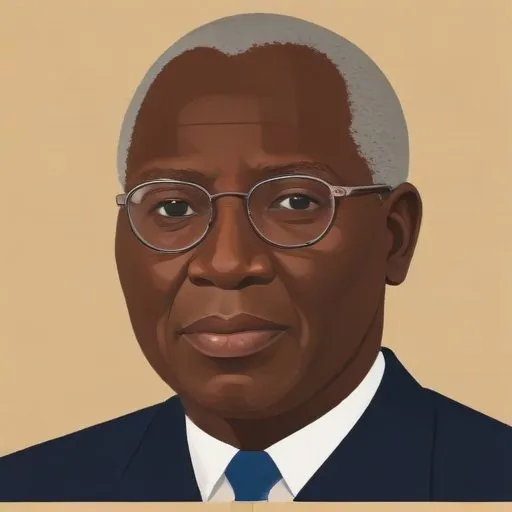
A Senegalese lawyer and politician who served as the 2nd President of Senegal, known for his efforts to promote democracy and economic development in West Africa.
Abdou Diouf, a Senegalese politician, is renowned for being the second President of Senegal, serving from 1981 to 2000, and later, the second Secretary-General of the Organisation internationale de la Francophonie from 2003 to 2014. His remarkable legacy is marked by his peaceful ascension to power and voluntary departure from office, setting a rare precedence in African politics.
Born on September 7, 1935, in Louga, Senegal, Diouf hails from a Serer father and an Halpulaar mother. His educational pursuits took him to the Lyce Faidherbe in Saint-Louis, Senegal, and later to Dakar University, where he studied law. He further honed his skills at the Sorbonne in Paris, graduating in 1959.
Diouf's political career began in 1960 when he became the Director of International Technical Cooperation. He subsequently held various key positions, including assistant to the Secretary-General of the Government, Secretary-General of the Ministry of Defense, and Governor of the Sine-Saloum Region. In 1961, he joined the Senegalese Progressive Union (UPS), which later became the Socialist Party of Senegal.
In 1964, Diouf became Director of the Cabinet of President Léopold Senghor, a position he held until 1965. He later served as Secretary-General of the Presidency, Minister of Planning and Industry, and eventually, Prime Minister in 1970.
In 1981, Diouf succeeded Léopold Senghor as the President of Senegal, marking the first peaceful transfer of power in West Africa. During his presidency, Diouf introduced several reforms, including the decentralization of power and the promotion of rural development. He also played a crucial role in maintaining regional stability, particularly in the resolution of the Casamance conflict.
In 2000, Diouf voluntarily stepped down from power after losing the presidential election to Abdoulaye Wade, setting a rare precedent in African politics. This peaceful transfer of power earned him international recognition and respect.
In 2003, Diouf became the second Secretary-General of the Organisation internationale de la Francophonie, a position he held until 2014. During his tenure, he worked tirelessly to promote linguistic and cultural diversity, as well as support democracy and human rights in Francophone countries.
Throughout his career, Diouf has received numerous awards and honors for his contributions to peace, democracy, and human rights. He remains an influential figure in African politics, known for his commitment to peaceful leadership and regional unity.
Abdou Diouf's life and legacy serve as a testament to the power of peaceful leadership, democratic values, and regional unity. His commitment to promoting these ideals has left an indelible mark on African politics and the global community.
Born in 1926
The 3rd President of Senegal, a renowned academic and politician, served from 2000 to 2012, implementing economic reforms and promoting regional stability. He's known for his efforts to modernize Senegal's infrastructure and economy.
Born in 1923
A pioneering scholar who merged anthropology, history, and physics to reclaim and redefine African cultural heritage and identity, challenging prevailing Eurocentric narratives.
Born in 1906
First president of Senegal and a renowned poet, known for promoting African culture and unity through his writings and political leadership.
Born in 1922
First President of Guinea, led country to independence from France in 1958, and implemented socialist policies. Known for his Pan-Africanism and anti-colonial stance.
Born in 1922
First President of Tanzania, led the country to independence from British colonial rule and implemented socialist policies, known for his Pan-Africanism and anti-colonialism efforts.
Born in 1924
First president of Zambia, leading the country to independence from British colonial rule and advocating for African unity and development.
