


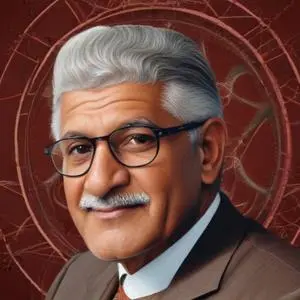
Developed Pakistan's nuclear program, making it the 7th country to possess nuclear weapons, and was involved in a global nuclear proliferation scandal.
Abdul Qadeer Khan is colloquially known as the father of Pakistan's atomic weapons program, a title earned through his tireless efforts to develop and strengthen Pakistan's nuclear capabilities. Born on April 1, 1936, Khan's work in metallurgical engineering and nuclear physics would go on to shape the course of Pakistan's history and earn him both national and international recognition.
Khan was born in Bhopal, India, but migrated to Pakistan in 1952, following the country's independence from British colonial rule. He went on to pursue higher education in Western Europe, studying metallurgical engineering at the Technical University of Berlin and later earning a doctorate in metallurgical engineering from the Catholic University of Leuven in Belgium.
In 1974, India's "Smiling Buddha" nuclear test shook the region, prompting Khan to join Pakistan's clandestine efforts to develop atomic weapons. It was in this context that Khan founded the Khan Research Laboratories (KRL) in 1976, serving as both its chief scientist and director for many years. Under Khan's leadership, KRL made significant strides in uranium metallurgy and isotope separation, paving the way for Pakistan's entry into the nuclear club.
In 2004, Khan was accused of running a nuclear proliferation network and was subjected to a debriefing by the Musharraf administration. Khan initially admitted to his role in the controversy, but later retracted his statements, pointing fingers at the Benazir Bhutto administration and President Musharraf. The controversy led to Khan's house arrest, which lasted until 2009, when he was freed after a court declared his debriefing unconstitutional.
Abdul Qadeer Khan's legacy is a complex one, marred by controversy and accusations of nuclear proliferation. However, his contributions to Pakistan's nuclear program are undeniable. His work at KRL helped Pakistan develop its nuclear capabilities, providing a sense of security and stability in a region marked by nuclear rivalry.
Khan was awarded the Nishan-e-Imtiaz, Pakistan's highest civilian honor, in 1999. He also received the Hilal-e-Pakistan in 1999, another prestigious Pakistani award.
Khan's life was marked by several significant events, including his migration to Pakistan in 1952 and the founding of KRL in 1976. His house arrest in 2004 and subsequent release in 2009 were also major milestones in his life.
Khan's work in the 1970s and 1980s was instrumental in shaping Pakistan's nuclear identity. His legacy continues to be felt in Pakistan, where he is revered as a national hero. His death on October 10, 2021, was marked by a state funeral, a testament to his enduring impact on Pakistani society.
As Pakistan marks the 50th anniversary of its nuclear program, Abdul Qadeer Khan's name is sure to be remembered as a pioneering figure who dared to dream big and push the boundaries of scientific innovation.
98 Years Old
A charismatic leader who served as Pakistan's president and prime minister, known for his socialist and nationalist policies, and his role in developing Pakistan's nuclear program.
Born in 1924
A Pakistani general and politician who ruled Pakistan from 1978 to 1988, implementing Islamic law and playing a key role in the Soviet-Afghan War. He's known for his authoritarian regime and controversial legacy.
82 Years Old
The Pakistani general and politician who seized power in a military coup and ruled Pakistan from 1999 to 2008, known for his controversial presidency and attempted assassination. He played a key role in Pakistan's politics and foreign policy during a tumultuous period.
72 Years Old
The first female Prime Minister of a Muslim-majority country, known for her efforts to democratize Pakistan and promote women's rights. She was a symbol of hope for a more liberal and tolerant Pakistan.
76 Years Old
The 12th Prime Minister of Pakistan, known for his three non-consecutive terms in office and his role in shaping the country's economy and foreign policy. He was ousted from power in 2017 due to corruption charges.
73 Years Old
A legendary cricketer who led Pakistan to World Cup victory in 1992, and later became the country's Prime Minister, known for his charismatic leadership and anti-corruption stance.
Born in 1889
India's first Prime Minister, a key figure in the country's struggle for independence from British rule, and a champion of democracy and secularism. He played a crucial role in shaping modern India's government and economy.
Born in 1917
The first female Prime Minister of India, serving from 1966 to 1977 and again from 1980 until her assassination in 1984, known for her strong leadership and economic reforms.
