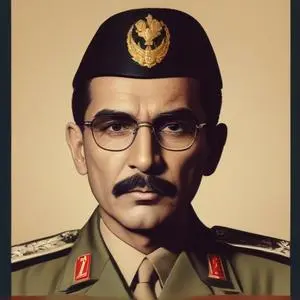
Muhammad Zia-ul-Haq

Muhammad Zia-ul-Haq

Muhammad Zia-ul-Haq was born on August 12th, 1924

Full Name: Muhammad Zia-ul-Haq
Nationality: Pakistani
Profession: General Politician
Place of Birth: Jalandhar India
Position: 6th President of Pakistan
Notable Work: Islamization of Pakistan
Born: 1924
Died: 1988

A Pakistani general and politician who ruled Pakistan from 1978 to 1988, implementing Islamic law and playing a key role in the Soviet-Afghan War. He's known for his authoritarian regime and controversial legacy.

Timeline
1924
Born in India
Muhammad Zia-ul-Haq was born on August 12, 1924, in Jalandhar, British India, to a family of modest means.
1947
Joined Pakistan Army
Zia joined the Pakistan Army after the country gained independence from British colonial rule.
1977
Seized power in military coup
Zia seized power in a military coup, overthrowing the government of Prime Minister Zulfikar Ali Bhutto.
1979
Executed Bhutto
Zia had Bhutto executed by hanging, sparking widespread outrage and international condemnation.
1988
Died in plane crash
Zia died in a mysterious plane crash on August 17, 1988, at the age of 64, leaving behind a legacy of controversy and authoritarian rule.
Muhammad Zia-ul-Haq

Muhammad Zia-ul-Haq Quiz

Muhammad Zia-ul-Haq's regime in Pakistan was characterized by

Score: 0/5
FAQ
What were the key policies of Muhammad Zia-ul-Haqs presidency?
Muhammad Zia-ul-Haqs presidency was marked by the introduction of Islamic law (Shariah), a military crackdown on political opposition, and a close alliance with the United States during the Soviet-Afghan War.
How did Muhammad Zia-ul-Haq come to power?
Muhammad Zia-ul-Haq seized power in a military coup in 1977, overthrowing the government of Prime Minister Zulfikar Ali Bhutto. He became the 6th President of Pakistan and ruled the country until his death in 1988.
What was Muhammad Zia-ul-Haqs stance on Islamization?
Muhammad Zia-ul-Haq was a strong advocate for the Islamization of Pakistan, introducing several laws and policies aimed at making the country more Islamic, including the introduction of Shariah courts and Islamic banking.
What was Muhammad Zia-ul-Haqs foreign policy legacy?
Muhammad Zia-ul-Haqs foreign policy was marked by a close alliance with the United States, which provided significant economic and military aid to Pakistan during the Soviet-Afghan War.
How did Muhammad Zia-ul-Haq die?
Muhammad Zia-ul-Haq died in a mysterious plane crash on August 17, 1988, along with several high-ranking military officers and the United States Ambassador to Pakistan, Arnold Raphel.

Related People:

Zulfikar Ali Bhutto

98 Years Old

A charismatic leader who served as Pakistan's president and prime minister, known for his socialist and nationalist policies, and his role in developing Pakistan's nuclear program.

Pervez Musharraf

82 Years Old

The Pakistani general and politician who seized power in a military coup and ruled Pakistan from 1999 to 2008, known for his controversial presidency and attempted assassination. He played a key role in Pakistan's politics and foreign policy during a tumultuous period.

Nawaz Sharif

76 Years Old

The 12th Prime Minister of Pakistan, known for his three non-consecutive terms in office and his role in shaping the country's economy and foreign policy. He was ousted from power in 2017 due to corruption charges.

Benazir Bhutto

72 Years Old

The first female Prime Minister of a Muslim-majority country, known for her efforts to democratize Pakistan and promote women's rights. She was a symbol of hope for a more liberal and tolerant Pakistan.

Asif Ali Zardari

70 Years Old

The 11th President of Pakistan, a shrewd politician and businessman who navigated the country's complex political landscape, known for his cunning and resilience in the face of adversity.

Yahya Khan

Born in 1917

The third President of Pakistan, a military dictator who ruled from 1969 to 1971, known for his role in the Bangladesh Liberation War and the country's subsequent division. He's infamous for his regime's atrocities and human rights abuses.

Ayub Khan

Born in 1907

Led the military coup in 1958, becoming the President of Pakistan and implementing various reforms, including the 1962 Constitution. He's known for his authoritarian rule and modernization efforts.

Ghulam Ishaq Khan

Born in 1915

A Pakistani businessman and politician who served as the 7th President of Pakistan, known for his economic reforms and stabilization of the country's economy during his tenure. He played a crucial role in shaping Pakistan's political and economic landscape.