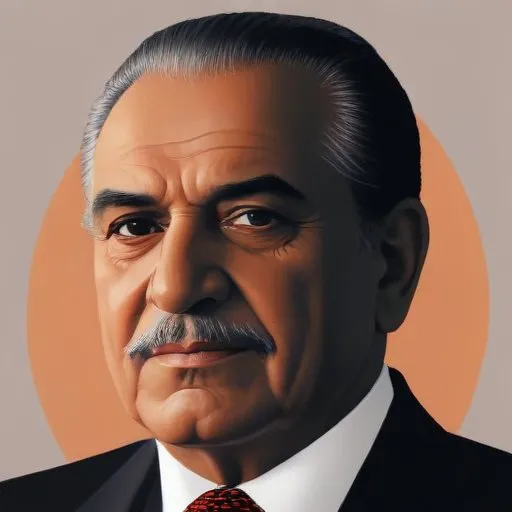
Ghulam Ishaq Khan: The Powerbroker of Pakistani Politics
Ghulam Ishaq Khan was a Pakistani bureaucrat, politician, and statesman who served as the seventh President of Pakistan from 1988 to 1993, playing a pivotal role in shaping the country's political landscape. He is known for his hawkish stance against Communist Afghanistan, his tumultuous relationships with Prime Ministers
Benazir Bhutto and
Nawaz Sharif, and his invocation of the Eighth Amendment to dismiss their governments.
Early Life and Career
Born on January 20, 1915, in Bannu, Ghulam Ishaq Khan graduated from Peshawar University and entered the Indian Civil Service. After Pakistan gained independence in 1947, he opted for Pakistan and began his bureaucratic career. In 1961, he was appointed the first Chairman of the Water and Power Development Authority by President
Ayub Khan. He later served as Finance Secretary from 1966 to 1970 and Governor of the State Bank from 1971 to 1975.
Rise to Prominence
Ghulam Ishaq Khan's rise to prominence began when he was appointed Defence Secretary in 1975, assisting with Pakistan's atomic bomb program. He was retained by President Zia-ul-Haq as Finance Minister in 1977, overseeing the country's highest GDP growth average. In 1985, he was elected Chairman of the Senate, a position he held until 1988.
Presidency and Controversies
After President Zia-ul-Haq's death in 1988, Ghulam Ishaq Khan was sworn in as President of Pakistan. During his tenure, he faced challenges from ethnic riots in Karachi and allegations of frustrating Prime Minister Benazir Bhutto's government. He invoked the Eighth Amendment and dismissed Bhutto's government in 1990, citing corruption and misgovernance. In 1993, he dismissed Nawaz Sharif's government on similar charges.
Legacy and Impact
Ghulam Ishaq Khan's legacy is marked by controversy and criticism. His dismissal of two consecutive governments sparked debates about the limits of presidential power and the role of the judiciary in Pakistani politics. Despite this, he played a significant role in shaping Pakistan's foreign policy, particularly in its relations with the United States and Afghanistan.
Personal Milestones and Trivia
- Ghulam Ishaq Khan was the oldest person to serve as President of Pakistan.
- He was known for his strict, no-nonsense approach to governance.
- He was a strong advocate for Pakistan's atomic bomb program.
Comparative Analysis with Contemporaries
Ghulam Ishaq Khan's leadership style and policies are often compared to those of his contemporaries, including Prime Ministers Benazir Bhutto and Nawaz Sharif. While Bhutto was seen as a more liberal and populist leader, Sharif was viewed as a conservative and business-friendly leader. Khan's hawkish stance on foreign policy and his invocation of the Eighth Amendment set him apart from his contemporaries.
Philosophical Contributions and Beliefs
Ghulam Ishaq Khan's philosophical contributions are largely reflected in his pragmatic approach to governance. He believed in the importance of a strong, centralized government and was willing to take bold decisions to ensure stability and security.
Historical Context and Legacy
Ghulam Ishaq Khan's legacy is deeply rooted in the historical context of Pakistan's tumultuous political landscape. His presidency marked a significant turning point in the country's history, setting the stage for future political developments. Today, he is remembered as a complex and controversial figure who left an indelible mark on Pakistani politics.
FAQ
What was Ghulam Ishaq Khans role in Pakistani politics?
Ghulam Ishaq Khan was the 7th President of Pakistan, serving from 1988 to 1993. During his presidency, he played a key role in stabilizing the countrys economy and strengthening its foreign relations. He also oversaw the countrys transition to democracy after the death of General Muhammad Zia-ul-Haq.
What were Ghulam Ishaq Khans achievements as president?
Ghulam Ishaq Khans presidency was marked by several significant achievements, including the introduction of economic reforms, the strengthening of the countrys judiciary, and the promotion of social welfare programs. He also played a key role in resolving the Kashmir dispute with India.
How did Ghulam Ishaq Khan become president of Pakistan?
Ghulam Ishaq Khan became president of Pakistan after the death of General Muhammad Zia-ul-Haq in 1988. He was the Chairman of the Senate at the time and took over as acting president, before being elected to the office in 1990.
What was Ghulam Ishaq Khans early life and education?
Ghulam Ishaq Khan was born in 1915 in the Northwest Frontier Province of British India. He studied at the University of Peshawar and later earned a masters degree in economics from the University of Cambridge.
What was Ghulam Ishaq Khans relationship with the military?
Ghulam Ishaq Khan had a complex relationship with the military, which played a significant role in Pakistani politics during his presidency. While he worked closely with the military to stabilize the country, he also faced opposition from military leaders who sought to limit his power.