


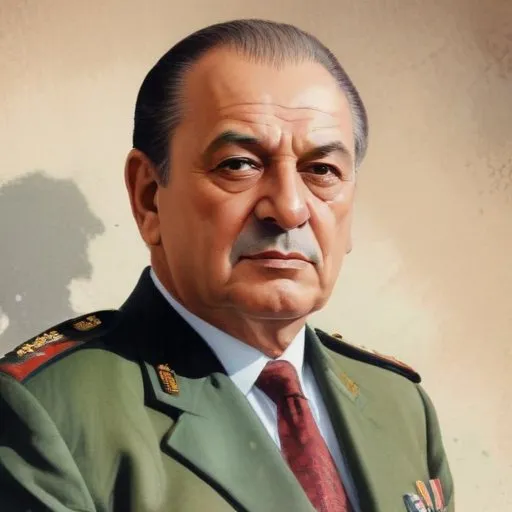
Led the military coup in 1958, becoming the President of Pakistan and implementing various reforms, including the 1962 Constitution. He's known for his authoritarian rule and modernization efforts.
Ayub Khan, a Pakistani military officer and politician, is best known for serving as the second President of Pakistan from 1958 to 1969. During his tenure, he implemented a series of reforms that transformed the country's politics, economy, and society, earning him both admiration and criticism.
Born on May 14, 1907, in Rehana, a small village in the Haripur district of North-West Frontier Province (now Khyber Pakhtunkhwa), Ayub Khan came from a humble background. His early life was marked by struggles, with his father, a Risaldar Major in the British Indian Army, passing away when Ayub was just six years old. Despite these challenges, he persevered and went on to attend the Royal Military College at Sandhurst, England, where he was commissioned as an officer in the British Indian Army in 1928.
Ayub Khan's military career spanned over three decades, during which he saw action in World War II and later served as the Commander-in-Chief of the Pakistani Army. In 1958, he seized power in a bloodless coup, ousting President Iskandar Ali Mirza and assuming the role of Chief Martial Law Administrator. Two years later, he became the President of Pakistan, a position he held until 1969.
Ayub Khan's presidency was marked by a range of reforms and policies that had far-reaching consequences for Pakistan. Some of his notable achievements include:
However, Ayub Khan's rule was also marred by controversy and criticism. Some of the most contentious issues include:
Ayub Khan's regime came to an end in 1969, when he stepped down in the face of mounting protests and opposition. He was succeeded by General Yahya Khan, who oversaw the country's first general elections in 1970. Ayub Khan's legacy remains divisive, with some hailing him as a visionary leader who brought stability and growth to Pakistan, while others criticize his authoritarian rule and marginalized groups.
Despite the controversy surrounding his rule, Ayub Khan's impact on Pakistan's history is undeniable. His reforms and policies continue to shape the country's politics, economy, and society, making him a figure of enduring significance in Pakistani history.
Born in 1876
Leader of the All-India Muslim League, instrumental in the creation of Pakistan, and its first head of state. He's revered as the "Father of the Nation" in Pakistan.
Born in 1895
First Prime Minister of Pakistan, leading the country to independence from British colonial rule and shaping its early years. Known for his role in the country's formative period.
Born in 1917
The third President of Pakistan, a military dictator who ruled from 1969 to 1971, known for his role in the Bangladesh Liberation War and the country's subsequent division. He's infamous for his regime's atrocities and human rights abuses.
98 Years Old
A charismatic leader who served as Pakistan's president and prime minister, known for his socialist and nationalist policies, and his role in developing Pakistan's nuclear program.
73 Years Old
The first female Prime Minister of a Muslim-majority country, known for her efforts to democratize Pakistan and promote women's rights. She was a symbol of hope for a more liberal and tolerant Pakistan.
82 Years Old
The Pakistani general and politician who seized power in a military coup and ruled Pakistan from 1999 to 2008, known for his controversial presidency and attempted assassination. He played a key role in Pakistan's politics and foreign policy during a tumultuous period.
70 Years Old
The 11th President of Pakistan, a shrewd politician and businessman who navigated the country's complex political landscape, known for his cunning and resilience in the face of adversity.
85 Years Old
The 12th President of Pakistan, a businessman-turned-politician who served from 2013 to 2018, known for maintaining a low profile and avoiding controversy during his tenure. He focused on economic development and strengthening international relations.
