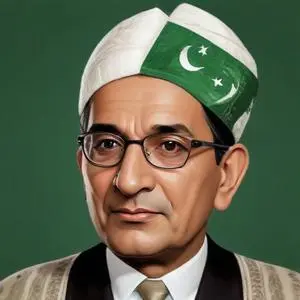
Liaquat Ali Khan: The Visionary Leader of Pakistan
A Statesman and a Founding Figure
Liaquat Ali Khan is revered as the Quaide-Millat, or Leader of the Nation, in Pakistan. He was the first Prime Minister of Pakistan, serving from 1947 until his assassination in 1951, and played a pivotal role in the country's formative years.
Early Life and Education
Born on October 1, 1895, in Karnal, East Punjab, Khan came from a wealthy family. His grandfather, Nawab Ahmad Ali, had provided significant support to the British during the Mutiny uprising of 1857-1858, earning him prestigious honors and complete remission of rent. Khan's education was marked by excellence, with him graduating from the Aligarh Muslim University and later from the University of Oxford.
Rise to Prominence
Initially, Khan was invited to join the Indian National Congress, but he later opted to join the All-India Muslim League, led by
Muhammad Ali Jinnah. He became Jinnah's right-hand man, assisting him in the campaign for a separate Muslim nation-state out of Hindu-majority India, which would eventually become the Pakistan Movement. Khan's democratic political theories and advocacy for parliamentarism in British India made him a prominent figure in the movement.
Premiership and Policies
As the first Prime Minister of Pakistan, Khan oversaw the country's early years, navigating the complex post-independence era and the onset of the Cold War. His foreign policy sided with the United States-led Western Bloc, over the Soviet Union-led Eastern Bloc. In 1949, he promulgated the Objectives Resolution, which stipulated Pakistan to be an Islamic democracy. During his tenure, he also held cabinet portfolios as the first foreign minister, defense minister, and frontier regions minister.
Challenges and Controversies
In March 1951, Khan survived an attempted coup by left-wing political opponents and segments of the Pakistani military. However, his premiership was cut short when he was assassinated on October 16, 1951, while delivering a speech in the Company Bagh of Rawalpindi.
Legacy and Impact
Liaquat Ali Khan's contributions to the creation and development of Pakistan are immeasurable. As a visionary leader, he played a crucial role in shaping the country's early years and its relations with the world. His legacy continues to inspire generations of Pakistanis, and his ideals of democracy, parliamentarism, and Islamic values remain an integral part of Pakistan's ethos.
Quotes and Memorable Sayings
- "Pakistan is destined to play a vital role in the comity of nations."
- "The Objectives Resolution is the grund norm of the Constitution of Pakistan."
Personal Milestones and Key Life Events
- 1895: Born on October 1, in Karnal, East Punjab
- 1947: Became the first Prime Minister of Pakistan
- 1949: Promulgated the Objectives Resolution
- 1951: Survived an attempted coup in March; assassinated on October 16
Inspirational Stories and Motivations
Liaquat Ali Khan's life is a testament to his unwavering commitment to the cause of Pakistan. His courage, vision, and leadership inspire generations to strive for greatness, making him an iconic figure in Pakistan's history.
FAQ
What was Liaquat Ali Khans role in the creation of Pakistan?
Liaquat Ali Khan was one of the leading figures in the Pakistan Movement, serving as the first Prime Minister of Pakistan after the countrys independence in 1947. He played a key role in negotiating the countrys boundaries and securing international recognition.
What is Liaquat Ali Khans connection to Muhammad Ali Jinnah?
Liaquat Ali Khan was a close ally and friend of Muhammad Ali Jinnah, the founder of Pakistan. The two men worked together to achieve independence from British rule and establish Pakistan as a sovereign state.
What were Liaquat Ali Khans economic policies?
Liaquat Ali Khan implemented a series of economic policies aimed at developing Pakistans economy, including the creation of the State Bank of Pakistan and the establishment of a nationalized industries program.
How did Liaquat Ali Khans assassination affect Pakistani politics?
Liaquat Ali Khans assassination in 1951 had a profound impact on Pakistani politics, leading to a period of instability and power struggles that lasted for decades. His death also paved the way for a series of military coups that would shape the countrys future.
What is Liaquat Ali Khans legacy in Pakistani history?
Liaquat Ali Khan is remembered as a national hero and a founder of Pakistan, known for his vision and leadership during the countrys formative years. His legacy continues to inspire Pakistani politicians and citizens alike.