


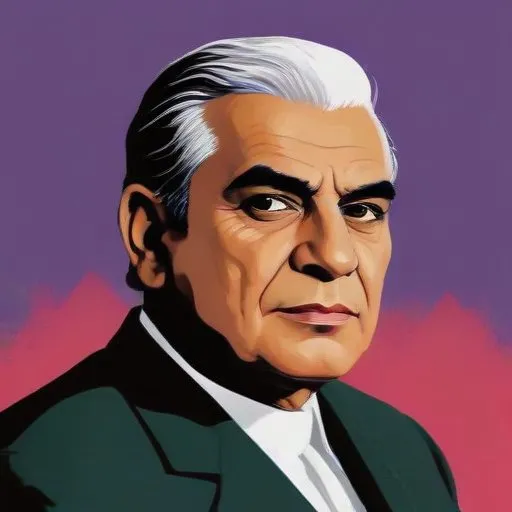
The third President of Pakistan, a military dictator who ruled from 1969 to 1971, known for his role in the Bangladesh Liberation War and the country's subsequent division. He's infamous for his regime's atrocities and human rights abuses.
Yahya Khan, a Pakistani military officer, is infamously remembered as the orchestrator of the 1971 Bangladesh genocide and the third president of Pakistan from 1969 to 1971. His tenure was marked by authoritarian rule, martial law, and the devastating consequences of Operation Searchlight, which led to the Bangladesh Liberation War and the eventual secession of East Pakistan.
Khan's military career began in 1939, when he was commissioned to the British Indian Army. During World War II, he fought in the Mediterranean theatre, earning promotion to major acting lieutenant-colonel. Following the creation of Pakistan in 1947, Khan advanced in the Pakistan Army, participating in the Second India-Pakistan War of 1965 and executing covert infiltration in Indian-administered Kashmir.
Khan's controversial appointment as Commander-in-Chief of the Pakistan Army in 1966 paved the way for his presidency. After Ayub Khan's resignation in March 1969, Yahya Khan succeeded him, suspending the constitution and imposing martial law.
In 1970, Khan oversaw Pakistan's first general election, only to block the power transition to the victorious Sheikh Mujibur Rahman from East Pakistan. This decision catalyzed the Bangladesh Liberation War, sparked by Operation Searchlight in March 1971. The brutal crackdown on Bengali nationalism resulted in the deaths of approximately 300,000 to 3,000,000 Bengalis and the rape of between 200,000 to 400,000 women.
The devastating consequences of the war and the eventual secession of East Pakistan led to Yahya Khan's resignation from the military command and the presidency in December 1971. He was succeeded by Zulfikar Ali Bhutto and placed under house surveillance until 1979. Khan died in 1980, buried in Peshawar.
Khan's political ideology was shaped by his military background and a strong sense of Pakistani nationalism. His presidency was marked by authoritarianism, and he believed in the necessity of a strong central government to maintain national unity.
Yahya Khan's presidency and the subsequent Bangladesh Liberation War had a profound impact on modern Pakistani and Bangladeshi society. The war led to the formation of Bangladesh and continues to shape the complex relations between the two nations.
Khan's military career was marked by his participation in World War II and the Second India-Pakistan War. His presidency was marked by his controversial appointment, the imposition of martial law, and the devastating consequences of Operation Searchlight.
Yahya Khan's presidency and the Bangladesh Liberation War are a painful reminder of the devastating consequences of authoritarianism, nationalism, and the suppression of self-determination. His legacy serves as a cautionary tale for modern political leaders, emphasizing the importance of respecting human rights and the principles of democracy.
98 Years Old
A charismatic leader who served as Pakistan's president and prime minister, known for his socialist and nationalist policies, and his role in developing Pakistan's nuclear program.
Born in 1907
Led the military coup in 1958, becoming the President of Pakistan and implementing various reforms, including the 1962 Constitution. He's known for his authoritarian rule and modernization efforts.
Born in 1924
A Pakistani general and politician who ruled Pakistan from 1978 to 1988, implementing Islamic law and playing a key role in the Soviet-Afghan War. He's known for his authoritarian regime and controversial legacy.
83 Years Old
The Pakistani general and politician who seized power in a military coup and ruled Pakistan from 1999 to 2008, known for his controversial presidency and attempted assassination. He played a key role in Pakistan's politics and foreign policy during a tumultuous period.
71 Years Old
The 11th President of Pakistan, a shrewd politician and businessman who navigated the country's complex political landscape, known for his cunning and resilience in the face of adversity.
76 Years Old
The 12th Prime Minister of Pakistan, known for his three non-consecutive terms in office and his role in shaping the country's economy and foreign policy. He was ousted from power in 2017 due to corruption charges.
77 Years Old
The 15th Prime Minister of Pakistan, a skilled economist who led the country's economic revival and implemented significant reforms, earning international recognition for his efforts.
73 Years Old
The first female Prime Minister of a Muslim-majority country, known for her efforts to democratize Pakistan and promote women's rights. She was a symbol of hope for a more liberal and tolerant Pakistan.
