


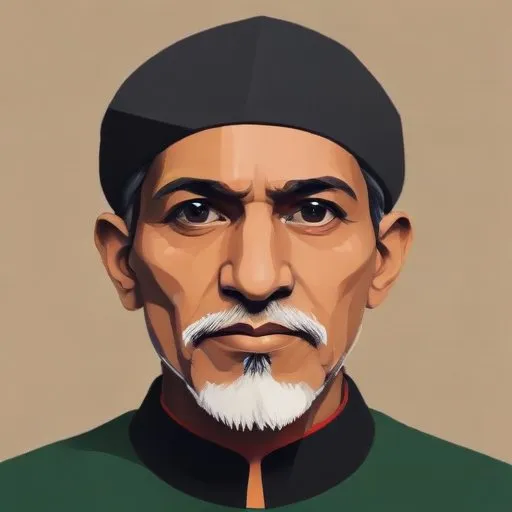
A renowned Islamic scholar and translator, best known for his English translation of the Quran, which is widely used and respected around the world.
Renowned for his meticulous translation of the Quran, Abdullah Yusuf Ali was a distinguished Islamic scholar, barrister, and writer who left an indelible mark on the understanding and appreciation of Islam worldwide. His magnum opus, "The Holy Quran: Text, Translation, and Commentary," remains a seminal work in the field, cherished by scholars and laymen alike.
Born on April 14, 1872, in Bombay, British India, Abdullah Yusuf Ali was the son of Yusuf Ali Allahbuksh, a Sunni Muslim who served as a Government Inspector of Police. Ali's early education took place at the Anjuman Himayatul Islam school and later at the missionary school Wilson College, where he developed a strong foundation in Arabic and English. He went on to receive a religious education, eventually memorizing the entire Quran.
In 1891, Ali graduated with a first-class Bachelor of Arts degree in English Literature from the University of Bombay, earning him a Presidency of Bombay Scholarship to study at the University of Cambridge in England. He pursued law at St. John's College, Cambridge, and later returned to India in 1895 to join the Indian Civil Service.
Ali's most significant contribution lies in his exhaustive translation and commentary of the Quran. His work, which spanned several years, aimed to present the Quran in a manner that was both faithful to the original Arabic text and accessible to readers unfamiliar with Islamic scripture. The result was a comprehensive, annotated translation that has become a benchmark for Islamic studies.
In addition to his Quranic scholarship, Ali wrote several books on Islam, including "The Life and Teachings of Muhammad" and "The Cultural Atlas of Islam." These works showcases his remarkable ability to distill complex theological concepts into lucid, engaging prose.
In recognition of his services to the British war effort during World War I, Ali was conferred the honor of Commander of the Order of the British Empire (CBE) in 1917.
Ali married Teresa Mary Shalders in 1900, and the couple had three sons and a daughter. His family settled in England, where he practiced law and devoted himself to his literary pursuits.
Abdullah Yusuf Ali's legacy extends far beyond his own life and work. His translation of the Quran has been widely acclaimed and remains a staple of Islamic studies. His commitment to promoting cross-cultural understanding and education has inspired generations of scholars, writers, and thinkers.
Through his writing, Ali sought to foster a deeper appreciation for Islamic thought and its rich cultural heritage. His remarkable life and work serve as a testament to the power of scholarship, dedication, and a lifelong pursuit of knowledge.
Ali's work must be viewed within the context of the late 19th and early 20th centuries, a time of significant cultural and intellectual flux. His translation of the Quran not only reflected his own erudition but also responded to the growing interest in Islamic studies in the Western world.
Comparing Ali's work to that of his contemporaries, such as Muhammad Asad and Muhammad Marmaduke Pickthall, highlights the distinctiveness of his approach. While all three scholars were committed to presenting Islam to a broader audience, Ali's exhaustiveness, attention to detail, and linguistic virtuosity set him apart.
Abdullah Yusuf Ali's life and work serve as a beacon of inspiration, reminding us of the transformative power of education, scholarship, and devotion. His legacy continues to enlighten and enrich our understanding of Islam, fostering a deeper appreciation for the rich cultural heritage of the Islamic world.
Born in 1877
A Pakistani philosopher, poet, and politician who played a key role in the creation of Pakistan and is revered for his philosophical and literary works that explored Islamic identity and nationalism.
Born in 1889
India's first Prime Minister, a key figure in the country's struggle for independence from British rule, and a champion of democracy and secularism. He played a crucial role in shaping modern India's government and economy.
Born in 1869
Indian freedom fighter, activist, and philosopher who led India to independence from British rule through non-violent civil disobedience, inspiring civil rights movements worldwide.
Born in 1888
A key figure in India's struggle for independence, he played a crucial role in shaping the country's education system and promoting unity among its diverse population.
Born in 1876
Leader of the All-India Muslim League, instrumental in the creation of Pakistan, and its first head of state. He's revered as the "Father of the Nation" in Pakistan.
Born in 1865
A leading figure in India's struggle for independence from British rule, known for his role in the Indian independence movement and his advocacy for Hindu-Muslim unity.
