


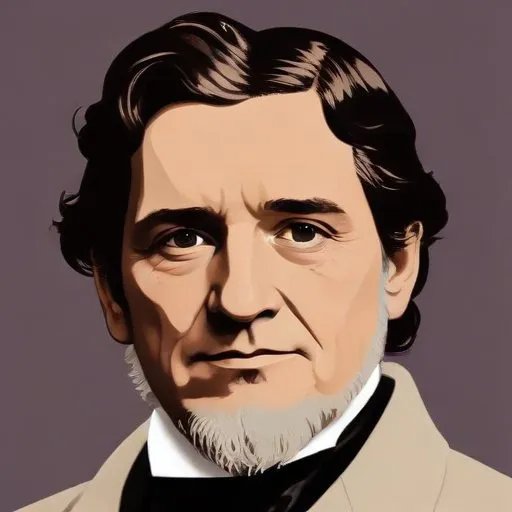
Founded the Cambridge School of Geology and was a pioneer in the field of stratigraphy, discovering the Cambrian Period and establishing the concept of geological time scales.
Adam Sedgwick, a British geologist and Anglican priest, is renowned for proposing the Cambrian and Devonian periods of the geological timescale, revolutionizing our understanding of the Earth's history. Through his groundbreaking work on Welsh rock strata, Sedgwick identified the Cambrian period in 1835, and later, in collaboration with Roderick Murchison, he proposed the Devonian period in 1840, resolving the Great Devonian Controversy.
Sedgwick was born on 22 March 1785 in Dent, Yorkshire, as the third child of an Anglican vicar. He received his education at Sedbergh School and Trinity College, Cambridge, where he studied mathematics and theology. Sedgwick obtained his BA in 1808 and his MA in 1811, ranking 5th Wrangler in his BA examination.
Sedgwick became a Fellow of Trinity College, Cambridge, and was appointed as the Woodwardian Professor of Geology at Cambridge in 1818, a position he held until his death in 1873. Although he had no prior knowledge of geology, Sedgwick dedicated himself to the field, studying the geology of the British Isles and Europe. His work on the classification of Cambrian rocks led to the establishment of the Cambrian period, a significant milestone in the field of geology.
Sedgwick's most notable contribution to geology is the proposal of the Cambrian and Devonian periods. The Cambrian period, identified in 1835, marked a significant turning point in the Earth's history, characterized by the rapid diversification of life on Earth. The Devonian period, proposed in 1840, filled a crucial gap in the geological timescale, resolving the Great Devonian Controversy surrounding the rocks near the boundary between the Silurian and Carboniferous periods.
Sedgwick played a significant role in guiding the young Charles Darwin in his early study of geology. Despite their friendly relationship, Sedgwick opposed Darwin's theory of evolution by means of natural selection, highlighting the complexities of the Earth's history and the limitations of human understanding.
Sedgwick was known for his strong opinions, including his opposition to the admission of women to the University of Cambridge. In one conversation, he referred to aspiring female students as "nasty forward minxes." Despite these controversies, Sedgwick remained a prominent figure in the scientific community, leaving behind a legacy of geological pioneering.
Adam Sedgwick's contributions to geology have had a lasting impact on our understanding of the Earth's history. His work on the Cambrian and Devonian periods has continued to shape our knowledge of the Earth's ancient past, influencing generations of geologists and scientists. Sedgwick's legacy serves as a testament to the power of human curiosity and the importance of scientific inquiry.
Born in 1797
A Scottish geologist who pioneered the concept of uniformitarianism, which states that the Earth's geological features were shaped by slow, gradual processes over millions of years. His work laid the foundation for modern geology and influenced Charles Darwin's theory of evolution.
Born in 1784
A pioneering geologist and paleontologist who discovered dinosaur fossils and coined the term "coprolite" for fossilized dung, making significant contributions to the field of paleontology.
75 Years Old
Astronaut and captain who flew on three Space Shuttle missions, logging over 200 days in space, and conducted numerous scientific experiments. He's also known for his work on the International Space Station.
Born in 1809
Developed the theory of evolution through natural selection, revolutionizing our understanding of life on Earth. This groundbreaking idea transformed the fields of biology, ecology, and beyond.
