


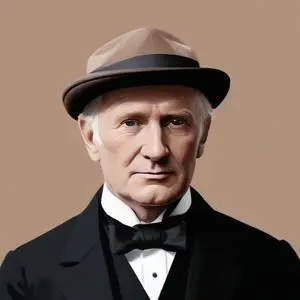
A Scottish geologist who pioneered the concept of uniformitarianism, which states that the Earth's geological features were shaped by slow, gradual processes over millions of years. His work laid the foundation for modern geology and influenced Charles Darwin's theory of evolution.
Charles Lyell, a Scottish geologist, revolutionized the way we understand the Earth's history, cementing his place as one of the most influential scientists of the 19th century. Through his groundbreaking work, Lyell demonstrated the power of known natural causes in explaining the Earth's history, earning him the title of the "Father of Modern Geology."
Born on November 14, 1797, Lyell grew up in a family of modest means, but his intellect and curiosity led him to pursue higher education. He studied law at Exeter College, Oxford, but his true passion lay in geology. Lyell's fascination with the Earth's formation and evolution propelled him to become a prominent figure in the scientific community.
In 1830, Lyell published his magnum opus, Principles of Geology, a three-volume masterpiece that presented the idea that the Earth was shaped by the same natural processes still in operation today, operating at similar intensities. This gradualistic view, dubbed "uniformitarianism" by philosopher William Whewell, contrasted with the prevailing catastrophic view of the time. Lyell's eloquent and evidence-based argument convinced a wide range of readers, including the renowned Charles Darwin, and laid the foundation for modern geological thought.
Lyell's contributions to science were multifaceted and far-reaching. He pioneered explanations of climate change, proposing that shifting boundaries between oceans and continents could explain long-term variations in temperature and rainfall. His work on earthquakes and volcanoes provided new insights into the Earth's internal dynamics. In stratigraphy, Lyell's division of the Tertiary period into the Pliocene, Miocene, and Eocene remains a cornerstone of modern geology.
Lyell's work had a profound impact on modern society, extending beyond the scientific community. His ideas about gradual change and uniformitarianism influenced Charles Darwin's thoughts on evolution, shaping the course of biological science. Lyell's emphasis on the significance of deep time in understanding the Earth and environment paved the way for modern environmentalism and conservation efforts.
Lyell's life was marked by significant milestones, including his election as a fellow of the Royal Society in 1826 and his appointment as president of the Geological Society of London in 1831. In 1848, he was knighted for his contributions to science. Lyell's close friendship with Charles Darwin, as well as his active support of Darwin's work, is a testament to his collaborative spirit and commitment to advancing scientific knowledge.
Charles Lyell's legacy extends far beyond his own lifetime. His work laid the foundation for modern geology, influencing generations of scientists and shaping our understanding of the Earth's history. Lyell's emphasis on the importance of observation, evidence, and gradual change has had a lasting impact on the scientific community, making him one of the most important figures in the history of geology.
"The present is the key to the past, and the past is the key to the present."
This quote, often attributed to Lyell, encapsulates his uniformitarian approach to geology, highlighting the importance of understanding present-day processes in interpreting the Earth's history.
Born in 1809
Developed the theory of evolution through natural selection, revolutionizing our understanding of life on Earth. This groundbreaking idea transformed the fields of biology, ecology, and beyond.
Born in 1785
Founded the Cambridge School of Geology and was a pioneer in the field of stratigraphy, discovering the Cambrian Period and establishing the concept of geological time scales.
65 Years Old
A pioneering golfer who won multiple PGA Tour events and was a member of the Ryder Cup team, known for his consistent play and sportsmanship.
Born in 1726
Pioneering geologist and physician who formulated the theory of uniformitarianism, proposing that the Earth's geological features were shaped by slow, gradual processes over millions of years.
Born in 1769
Founded the field of comparative anatomy, establishing extinction as a fact and creating a framework for understanding the natural world through fossil records.
Born in 1744
A French soldier, biologist, and academic who developed a theory of inheritance of acquired characteristics, proposing that organisms adapt to their environment and pass on those traits to their offspring.
Born in 1823
A pioneering naturalist who discovered evolution through natural selection, independently of Charles Darwin, and contributed significantly to the field of biogeography.
