


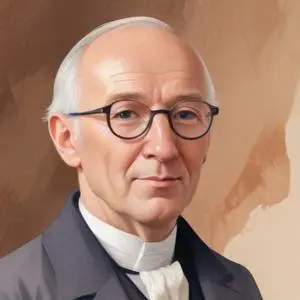
Pioneering geologist and physician who formulated the theory of uniformitarianism, proposing that the Earth's geological features were shaped by slow, gradual processes over millions of years.
James Hutton is renowned for his groundbreaking contributions to the field of geology, earning him the title "Father of Modern Geology." He revolutionized the way we understand the Earth's history, proposing that the physical world's remote past can be inferred from evidence in present-day rocks.
Hutton was born on June 3, 1726, in Edinburgh, Scotland, to Sarah Balfour and William Hutton, a merchant. After his father's death in 1729, Hutton's education became a priority. He attended the High School of Edinburgh, where he developed a keen interest in mathematics and chemistry. At the age of 14, he enrolled in the University of Edinburgh, studying the classics.
Hutton's most significant contribution to geology was his theory of uniformitarianism. He proposed that geological features are shaped by continuing natural processes over an indefinitely long period, rather than by catastrophic events. This idea challenged the prevailing view that the Earth was young and had been shaped by a series of sudden, violent events.
Hutton's work was heavily influenced by his observations of the Scottish landscape, particularly the Salisbury Crags and Siccar Point. He recognized that the geological features he saw could not be static, but rather were the result of ongoing transformation over millions of years.
Hutton's uniformitarianism theory posits that the Earth's surface has been shaped by the same geological processes that operate today. This idea has far-reaching implications, as it suggests that the Earth is much older than previously thought.
Hutton's work has had a profound impact on our understanding of the natural world. His theories have influenced fields beyond geology, including environmental science, ecology, and even astronomy.
Today, Hutton's legacy continues to inspire scientists and researchers around the world. His work serves as a reminder of the importance of empirical observation, scientific inquiry, and the pursuit of knowledge.
In 1768, Hutton was appointed as a physician to the Edinburgh Royal Infirmary, a position he held until 1793. He was also a fellow of the Royal Society of Edinburgh and the Royal College of Physicians of Edinburgh.
Hutton never married and had no children. He died on March 26, 1797, leaving behind a legacy that continues to shape our understanding of the natural world.
James Hutton's contributions to geology have had a lasting impact on our understanding of the Earth's history. He will forever be remembered as the "Father of Modern Geology," a pioneer who paved the way for future generations of scientists.
Hutton's work serves as a testament to the power of human curiosity, dedication, and perseverance. His legacy continues to inspire us to explore, to discover, and to push the boundaries of human knowledge.
Born in 1797
A Scottish geologist who pioneered the concept of uniformitarianism, which states that the Earth's geological features were shaped by slow, gradual processes over millions of years. His work laid the foundation for modern geology and influenced Charles Darwin's theory of evolution.
Born in 1785
Founded the Cambridge School of Geology and was a pioneer in the field of stratigraphy, discovering the Cambrian Period and establishing the concept of geological time scales.
Born in 1809
Developed the theory of evolution through natural selection, revolutionizing our understanding of life on Earth. This groundbreaking idea transformed the fields of biology, ecology, and beyond.
Born in 1728
Discovered magnesium and isolated carbon dioxide, making significant contributions to the field of chemistry.
