


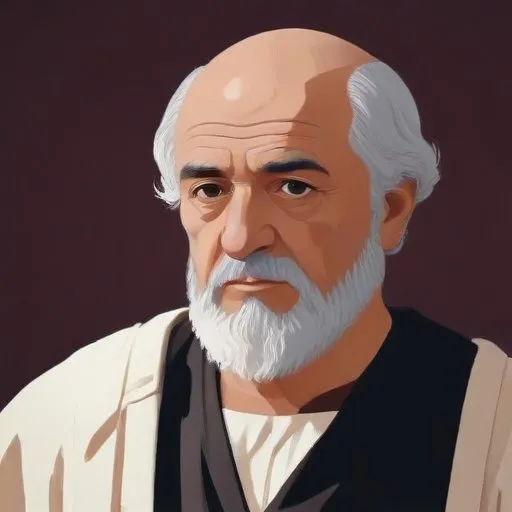
A Greek-French philosopher and scholar who played a key role in the Greek Enlightenment, modernizing Greek education and language, and promoting democratic and liberal ideas. His work laid the groundwork for the emergence of modern Greece.
Adamantios Korais, a Greek scholar and philosopher, is credited with laying the foundations of modern Greek literature and paving the way for the Greek War of Independence. His contributions to the Greek language and culture are unparalleled, earning him a reputation comparable to that of Dante on Italian and Martin Luther on German.
Born on April 27, 1748, in Smyrna, Korais was the son of Ioannis, a demogrontas (a seat similar to the prokritoi of mainland Greece) of Chian descent. He showed an exceptional passion for philosophy, literacy, and linguistics from an early age, studying extensively throughout his youth.
Korais initially studied in his hometown, Smyrna, where he graduated from the Evangelical Greek School. He then lived in Amsterdam as a merchant, but his thirst for knowledge soon led him to pursue higher education. He studied medicine at the University of Montpellier from 1782 to 1787, earning his diploma thesis in 1786 with Pyretologiae Synopsis and his doctoral thesis in 1787 with Medicus Hippocraticus.
Korais' travels took him to Paris, where he dedicated himself to translating ancient Greek authors and producing thirty volumes of those translations. This monumental work established him as one of the first modern Greek philologists and publishers of ancient Greek literature.
His translations aimed to purify the Greek language, eliminating Byzantine influences and promoting a more classical approach. This effort led to the emergence of Katharevousa, a purified form of the Greek language that would shape the country's cultural identity.
Korais' work had a profound impact on modern Greek literature and culture. His translations and philosophical writings inspired a generation of Greek scholars, writers, and thinkers, paving the way for the Greek Enlightenment.
His influence extended beyond literature, contributing to the Greek War of Independence and shaping the country's struggle for independence from the Ottoman Empire.
Adamantios Korais' contributions to modern Greek literature and culture are still celebrated today. His work not only shaped the Greek language but also inspired a nation to strive for independence and cultural identity.
In recognition of his achievements, Korais is often regarded as the "Father of Modern Greek Literature." His legacy continues to influence Greek scholars, writers, and thinkers, solidifying his place in the annals of Greek history.
Born in 1694
A witty and insightful 18th-century writer and philosopher who used satire to critique societal norms and advocate for reason, tolerance, and human rights.
Born in 1712
A pioneering thinker who shaped modern democracy and education with his ideas on social contracts, general will, and the importance of early childhood education. His writings influenced the French Revolution and modern political thought.
Born in 1724
Developed influential philosophical frameworks, such as the Critique of Pure Reason, that shaped modern Western thought on ethics, morality, and human understanding.
Born in 1717
A French Enlightenment thinker who made significant contributions to mathematics, physics, and philosophy, particularly in the fields of fluid dynamics and the study of vibrating strings. He's also known for his work on the Encyclopedia, a comprehensive reference work that aimed to compile all knowledge of the time.
Born in 1689
A French lawyer and philosopher who developed the concept of separation of powers, which divides a government into legislative, executive, and judicial branches to prevent abuse of power. His ideas greatly influenced modern democracy.
Born in 1741
A witty and insightful French writer who penned biting social commentary and clever aphorisms, known for his sharp observations on human nature and society.
Born in 1647
A 17th-century philosopher and writer who critiqued religious intolerance and advocated for reason, skepticism, and intellectual freedom. His works influenced the Enlightenment and modern critical thinking.
