


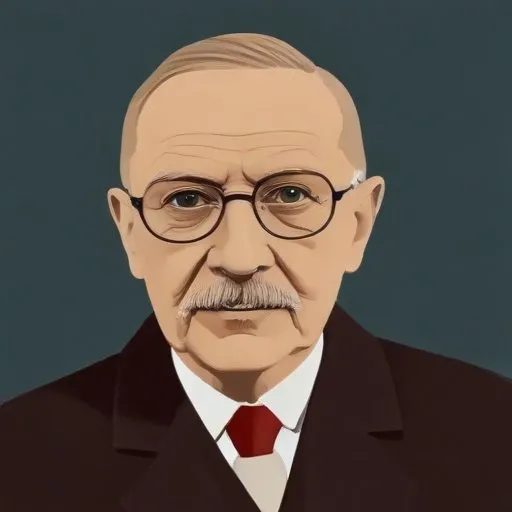
A German biochemist and academic who discovered the sex hormones estrogen and testosterone, and was awarded the Nobel Prize in Chemistry in 1939.
Adolf Butenandt, a German biochemist, is renowned for his groundbreaking research on sex hormones, which earned him the Nobel Prize in Chemistry in 1939. His work on the isolation and characterization of sex hormones, particularly estrogen and testosterone, revolutionized the field of biochemistry and paved the way for significant advances in medicine.
Butenandt was born on March 24, 1903, in Lehe, near Bremerhaven, Germany. He began his academic pursuit at the University of Marburg and later moved to the University of Göttingen, where he earned his Ph.D. in chemistry in 1927 under the guidance of Nobel laureate Adolf Windaus. His doctoral research focused on the chemistry of the insecticidal toxin found in the roots of Derris elliptica, which he successfully isolated and characterized.
Butenandt's academic career progressed rapidly, with him becoming a lecturer at the University of Göttingen in 1931. In 1933, he became a professor ordinarius at the Technical University of Danzig, where he continued his research on sex hormones. His work during this period led to the discovery of the structure of estrogen, a breakthrough that would change the face of biochemistry.
In 1936, Butenandt became the director of the Kaiser Wilhelm Institut (later the Max Planck Institute for Biochemistry) in Berlin-Dahlem, a position he held until 1960. During his tenure, he led the institute to become a hub for cutting-edge research in biochemistry.
Butenandt's work on sex hormones earned him the Nobel Prize in Chemistry in 1939. Although he initially rejected the award due to government policy, he accepted it in 1949 after World War II.
In addition to his work on sex hormones, Butenandt made significant contributions to the field of biochemistry. He discovered the structure of the sex pheromone of silkworms, which he named bombykol, in 1959. He also made important contributions to the study of rotenones, a group of insecticidal compounds.
Butenandt's work has had a lasting impact on the field of biochemistry and medicine. His research on sex hormones paved the way for the development of new treatments for hormonal disorders and infertility. He is remembered as a pioneer in his field, and his contributions continue to inspire new generations of scientists.
Butenandt was a member of the NSDAP (Nazi Party) from 1936, and his work was supported by the Nazi government. However, his involvement with the party has been the subject of controversy, and his legacy has been debated among historians and scholars.
Adolf Butenandt passed away on January 18, 1995, leaving behind a legacy of groundbreaking research and contributions to the field of biochemistry.
Born in 1903
A renowned expert in animal behavior, he pioneered the study of instinct and imprinting, and is famous for his work on aggression and his book "On Aggression".
Born in 1898
A high-ranking officer in the German Wehrmacht during World War II, known for his involvement in the July 20 plot to assassinate Adolf Hitler.
Born in 1881
Developed groundbreaking theories on polymers, revolutionizing the field of organic chemistry, and was awarded the Nobel Prize in Chemistry in 1953.
Born in 1898
Developed groundbreaking catalysts that revolutionized the production of plastics and led to the creation of new materials, earning a Nobel Prize in Chemistry.
