


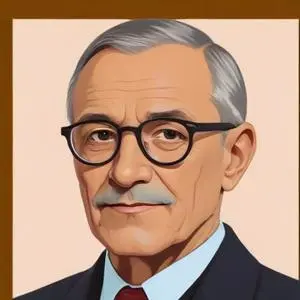
Developed groundbreaking catalysts that revolutionized the production of plastics and led to the creation of new materials, earning a Nobel Prize in Chemistry.
Ziegler's family connections introduced him to notable individuals, including Emil Adolf von Behring, the developer of the diphtheria vaccine. His academic excellence earned him an award for being the most outstanding student in his final year at high school in Kassel, Germany.
His dissertation, "Studies on semibenzole and related compounds," led to three publications. Ziegler's research focused on organometallic compounds, free radicals, and many-membered rings, ultimately leading to the development of the Ziegler-Natta catalyst.
Ziegler's contributions to the field of chemistry have inspired generations of scientists, and his work continues to influence the development of new materials and technologies.
Karl Ziegler's remarkable journey, from his early interest in science to his groundbreaking contributions to chemistry, has left an indelible mark on the scientific community.
Born in 1903
Developed groundbreaking synthetic polymers, revolutionizing plastics and fibers, and was awarded the Nobel Prize in Chemistry in 1963.
Born in 1881
A leading figure in Austrian socialism, he played a key role in shaping the country's post-WWI government and was a prominent advocate for democratic socialism. His writings on Marxism and nationalism remain influential.
Born in 1881
Developed groundbreaking theories on polymers, revolutionizing the field of organic chemistry, and was awarded the Nobel Prize in Chemistry in 1953.
Born in 1857
A Swiss psychiatrist who coined the term "schizophrenia" and developed a more humane approach to treating mental illnesses, also advocating for forced sterilization of people with mental disabilities.
Born in 1868
Developed a process to synthesize ammonia, revolutionizing agriculture and warfare, and was awarded the Nobel Prize in Chemistry in 1918.
Born in 1874
Developed the Haber-Bosch process, a method to produce ammonia on an industrial scale, revolutionizing fertilizer production and agriculture. This innovation had a profound impact on global food supply and population growth.
Born in 1884
Developed a method for the high-pressure hydrogenation of coal, allowing for the production of synthetic fuels and lubricants, revolutionizing the petroleum industry. Known for his groundbreaking work in organic chemistry.
Born in 1879
Developed the Meerwein-Ponndorf-Verley reduction, a crucial method for reducing aldehydes and ketones, and made significant contributions to organic chemistry. His work has had a lasting impact on the field.
