


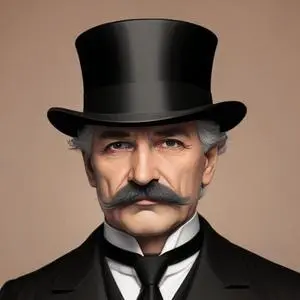
Founded the multinational conglomerate Siemens, revolutionizing telecommunications and electrical engineering with groundbreaking inventions like the dynamo and electric tramway. He transformed the industry with innovative solutions and entrepreneurial spirit.
Werner von Siemens, the German electrical engineer, inventor, and industrialist, is renowned for founding the electrical and telecommunications conglomerate Siemens, and pioneering groundbreaking innovations such as the electric tram, trolley bus, electric locomotive, and electric elevator.
Born on December 13, 1816, in Lenthe, near Hannover, in the Kingdom of Hanover, Werner von Siemens was the fourth of fourteen children to Christian Ferdinand Siemens and his wife Eleonore Deichmann. His family, an old and esteemed one from Goslar, had been documented since 1384.
After completing his schooling, Siemens joined the Prussian Military Academy's School of Artillery and Engineering, where he received his officer's training between 1835 and 1838. During his time in the military, he was decorated with various medals and contributed to the invention of electrically charged sea mines, used to combat the Danish blockade of Kiel.
Upon returning from war, Siemens devoted himself to perfecting existing technologies, which eventually led to his recognition worldwide for his advances in various fields. His first invention, sold to Elkington of Birmingham in 1843, marked the beginning of his illustrious career.
In 1847, Siemens invented a telegraph that utilized a needle to point to the correct letter, rather than relying on Morse code. This innovation led to the establishment of Telegraphen-Bauanstalt von Siemens & Halske on October 1, 1847, with his partner Johann Georg Halske.
Werner von Siemens' contributions to science and technology have left an indelible mark on modern society. The SI unit of electrical conductance, the siemens, is a testament to his enduring influence. His life's work has inspired generations of engineers, inventors, and entrepreneurs, cementing his status as one of the most important figures in the history of electrical engineering.
Siemens was a man of strong convictions and a passion for education. He believed in the importance of scientific education and was committed to promoting it throughout his life. His philanthropic endeavors included supporting educational institutions and advancing scientific knowledge.
Werner von Siemens received numerous accolades for his contributions to science and technology, including the Grand Gold Medal of the Exhibition of 1851 in London and the Copley Medal of the Royal Society in 1883.
As we reflect on the life and achievements of Werner von Siemens, we are reminded of the profound impact one individual can have on the course of human progress. His unwavering dedication to innovation, education, and philanthropy continues to inspire us today, over a century after his passing on December 6, 1892.
Born in 1816
Founded the multinational conglomerate Siemens, revolutionizing telecommunications and electrical engineering with groundbreaking inventions like the dynamo and electric tramway. He transformed the industry with innovative solutions and entrepreneurial spirit.
Born in 1912
The last communist leader of East Germany, known for his rigid adherence to Soviet ideology and his role in constructing the Berlin Wall.
Born in 1918
A German leader who served as Chancellor from 1974 to 1982, known for his pragmatic and socially liberal policies, and his key role in shaping the European Union. He was also a respected economist and published author.
