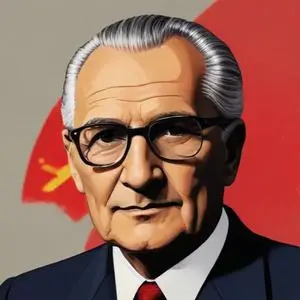
Erich Honecker: The Controversial Leader of East Germany
Who was Erich Honecker?
Erich Honecker was a German communist politician who led the German Democratic Republic, also known as East Germany, from 1971 until the fall of the Berlin Wall in 1989. He is notoriously remembered as the leader who constructed the Berlin Wall, a physical barrier that divided East and West Berlin, and enforced strict communist policies that restricted the freedom of his citizens.
Rise to Power
Honecker's political career began in the 1930s as an official of the Communist Party of Germany. After being imprisoned by the Nazis, he was freed by the Soviet army and relaunched his political activities, founding the Free German Youth, the youth organization of the Socialist Unity Party of Germany (SED), in 1946. He served as the group's chairman until 1955 and later became the Security Secretary of the SED Central Committee, a position that made him the prime organizer of the Berlin Wall's construction in 1961.
Leadership of East Germany
In 1970, Honecker initiated a political power struggle that led to him replacing
Walter Ulbricht as General Secretary of the SED and Chairman of the National Defence Council. Under his command, East Germany adopted a program of consumer socialism and moved towards the international community by normalizing relations with West Germany and becoming a full member of the United Nations.
Economic and Social Policies
Honecker's regime was marked by a focus on consumer socialism, which aimed to improve the standard of living of East Germans by increasing the availability of consumer goods and services. This approach led to a significant improvement in the country's economic performance, with East Germany becoming one of the most successful economies in the Eastern Bloc. However, the regime's strict controls on the economy and citizens' lives led to widespread dissatisfaction and resistance.
The Berlin Wall and Human Rights Abuses
Honecker's regime is infamous for its human rights abuses, particularly the construction of the Berlin Wall, which led to the deaths of hundreds of people attempting to cross the border. The regime also maintained a large-scale surveillance system, with the Stasi, the East German secret police, monitoring and controlling citizens' lives.
Fall from Power and Legacy
As Cold War tensions eased in the late 1980s, Honecker refused to implement reforms, leading to widespread protests and demonstrations. In October 1989, he was forced to resign as General Secretary of the SED and Chairman of the National Defence Council. He died in 1994, aged 81, while awaiting trial for his role in the Berlin Wall shootings.
Personal Life and Relationships
Honecker was born on August 25, 1912, in Neunkirchen, Saarland, Germany. He married Margot Feist in 1946, and they had one daughter, Sonja. Honecker was known for his close relationships with Soviet leaders, including
Leonid Brezhnev, who supported his rise to power.
Philosophical Contributions and Beliefs
Honecker was a devoted communist who believed in the ideology of Marxism-Leninism. He saw the construction of the Berlin Wall as a necessary measure to protect East Germany from the perceived threats of Western capitalism.
Influence on Modern Society
Honecker's regime had a profound impact on modern society, highlighting the dangers of totalitarianism and the importance of human rights and freedoms. His legacy serves as a reminder of the consequences of unchecked power and the importance of democratic values.
Trivia and Fun Facts
- Honecker was known for his passion for photography and was often seen carrying a camera.
- He was a member of the International Olympic Committee and was instrumental in East Germany's participation in the Olympic Games.
- Honecker's regime was notorious for its strict control over the media, with all newspapers and television channels subject to censorship.
Historical Context and Legacy
Honecker's regime was marked by a complex web of relationships with the Soviet Union and other Eastern Bloc countries. His legacy is shaped by the context of the Cold War and the divisions of post-war Germany. Today, he is remembered as a controversial figure who led a regime marked by human rights abuses and strict controls on citizens' lives.
FAQ
What was Erich Honeckers role in East German politics?
Erich Honecker was the General Secretary of the Socialist Unity Party of Germany and the Chairman of the State Council of the German Democratic Republic, effectively making him the leader of East Germany from 1971 to 1989.
How did Erich Honeckers policies affect the East German economy?
Erich Honeckers policies aimed to strengthen the socialist economy of East Germany, but ultimately led to economic stagnation and widespread corruption. His government relied heavily on subsidies from the Soviet Union to maintain power.
What was Erich Honeckers stance on human rights and dissent?
Erich Honeckers government was known for its strict suppression of human rights and dissent, with thousands of East Germans imprisoned or forced to flee the country for speaking out against the regime.
How did Erich Honeckers regime respond to the fall of the Berlin Wall?
Erich Honeckers regime initially responded to the fall of the Berlin Wall with violence and repression, but as the protests grew in scale and intensity, he was eventually forced to resign in October 1989.
What happened to Erich Honecker after the fall of the Berlin Wall?
After the fall of the Berlin Wall, Erich Honecker fled to the Soviet Union, where he remained until the Soviet Union collapsed in 1991. He was eventually extradited to Germany, where he was put on trial for human rights abuses and corruption, but died in 1994 before the trial could be completed.