


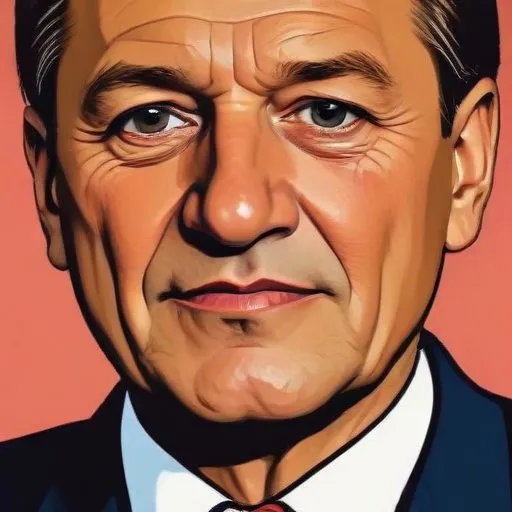
A journalist and politician who accidentally sparked the fall of the Berlin Wall by prematurely announcing new travel regulations, leading to a wave of protests and eventual reunification.
Günter Schabowski, a former East German politician, is best known for his infamous press conference in November 1989, where he inadvertently announced the opening of the Berlin Wall, marking a pivotal moment in modern German history. This momentous occasion precipitated the eventual collapse of the German Democratic Republic (GDR) and paved the way for German reunification.
Schabowski was born on January 4, 1929, in Anklam, Pomerania, then part of the Free State of Prussia, now Mecklenburg-Vorpommern. After completing his Abitur, he joined the Free German Trade Union Federation's newspaper, Tribüne, as an editor in 1947. He later studied journalism at the Karl Marx University in Leipzig's Red Monastery, the only institution in the GDR offering training to become a journalist.
In 1952, Schabowski became a member of the Socialist Unity Party of Germany (SED), the ruling party during most of the GDR's existence. He attended the party academy of the Communist Party of the Soviet Union from 1967 to 1968. Afterwards, he began a career in the newspaper Neues Deutschland, considered the leading newspaper in the GDR. He rose through the ranks, becoming editor-in-chief in 1978.
On November 9, 1989, Schabowski held a press conference, where he was asked about the GDR's new travel regulations. In a moment of improvisation, he announced that the government had decided to allow East Germans to travel to the West, effective immediately. This statement was met with euphoria, and thousands of people gathered at the Berlin Wall, demanding to be let through. The border guards, unsure of how to respond, eventually opened the gates, and the Berlin Wall was effectively breached.
Schabowski's announcement marked the beginning of the end of the GDR and the Berlin Wall. In the following weeks, the inner German border was opened, and the GDR was eventually dissolved. Schabowski's role in this process has been the subject of much debate, with some viewing him as an accidental hero, while others see him as a symbol of the GDR's failures.
After the fall of the GDR, Schabowski's political career was marked by controversy and criticism. He was expelled from the SED and later served as a witness in trials related to the GDR's human rights abuses. In his later years, Schabowski reflected on his role in the fall of the Berlin Wall, acknowledging that he had unintentionally sparked a chain reaction that changed the course of history.
"Das ist doch ein historischer Tag..." ("This is a historic day...") - Schabowski's words during the press conference, which became a symbol of the fall of the Berlin Wall.
Schabowski's role in the fall of the Berlin Wall serves as a testament to the complex and often unexpected nature of historical events. His legacy continues to be debated, with some viewing him as a symbol of the GDR's failures, while others see him as an accidental hero who played a pivotal role in shaping modern German history.
Born in 1912
The last communist leader of East Germany, known for his rigid adherence to Soviet ideology and his role in constructing the Berlin Wall.
Born in 1913
A German statesman who served as Chancellor of Germany, known for his efforts to reconcile with Eastern Europe and his "Ostpolitik" policy, earning him a Nobel Peace Prize.
Born in 1918
A German leader who served as Chancellor from 1974 to 1982, known for his pragmatic and socially liberal policies, and his key role in shaping the European Union. He was also a respected economist and published author.
82 Years Old
The 7th Chancellor of Germany, a lawyer-turned-politician, led the country from 1998 to 2005, implementing significant economic and social reforms. He's known for his efforts to modernize Germany and strengthen the European Union.
72 Years Old
The first female Chancellor of Germany, serving for 16 years, known for her leadership during the European sovereign-debt crisis and her role in shaping the European Union's policy. She's a highly influential figure in modern politics.
95 Years Old
The last leader of the Soviet Union, who introduced reforms that led to the end of the Cold War and the collapse of communism, earning a Nobel Peace Prize. He's known for his policies of glasnost and perestroika, which transformed the Soviet Union and the world.
Born in 1911
The charismatic leader who championed conservative policies, helped end the Cold War, and is often credited with restoring American pride and optimism. He's also remembered for his folksy, actor-honed communication style.
Born in 1924
The 41st President of the United States, a decorated war hero and skilled diplomat, led the country through the end of the Cold War and Gulf War. He's known for his foreign policy expertise and "kinder, gentler nation" vision.
