


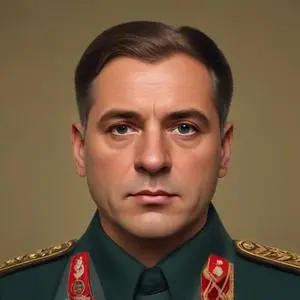
Led the German Democratic Republic (East Germany) from 1950 to 1971, implementing socialist policies and building the Berlin Wall. He's known for his strict communist rule and dividing a nation.
Walter Ulbricht, a German communist politician, is renowned for his pivotal role in shaping the German Democratic Republic (GDR) and serving as the chief decision-maker in East Germany from 1950 to 1971. His leadership spanned two decades, during which he implemented Stalinist policies, navigated the complexities of Cold War politics, and left an indelible mark on the country's history.
Born on June 30, 1893, in Leipzig, Germany, Ulbricht's early life was marked by a strong sense of social justice and a desire to challenge the existing political order. He joined the Social Democratic Party of Germany (SPD) in 1912, followed by the anti-World War I Independent Social Democratic Party of Germany (USPD) in 1917.
Ulbricht's political convictions deepened during World War I, and in 1918, he participated in the German Revolution, deserting the Imperial German Army in the process. This defining moment set the stage for his future involvement in communist politics.
In 1920, Ulbricht joined the Communist Party of Germany (KPD), rapidly rising through the ranks to become a leading party functionary. By 1923, he was a member of the Central Committee, a position that cemented his influence within the party.
Facing persecution by the Nazi regime, Ulbricht fled Germany in 1933, seeking refuge in Paris, Prague, and eventually, the Soviet Union. During his exile, he continued to play a crucial role in shaping communist ideology and strategy, earning the respect and admiration of Soviet leaders, including Joseph Stalin.
After World War II, Ulbricht returned to Germany, determined to rebuild the communist movement in the Soviet-occupied zone. He reorganized the KPD along Stalinist lines, paving the way for the establishment of the German Democratic Republic (GDR) in 1949.
In 1946, Ulbricht orchestrated the forced merger of the KPD and SPD into the Socialist Unity Party of Germany (SED), solidifying his position as the First Secretary of the SED and de facto leader of East Germany.
Ulbricht's leadership was marked by a series of controversies, including the violent suppression of the 1953 uprising in East Germany, in which the Soviet Army intervened to quell protests against the government. This event had far-reaching consequences, cementing Ulbricht's reputation as a hardline communist leader willing to take drastic measures to maintain control.
Another notable controversy surrounding Ulbricht was his insistence on the construction of the Berlin Wall in 1961, which was initially met with reluctance by the Kremlin. This move was seen as a symbol of Ulbricht's determination to protect East Germany's sovereignty and maintain the communist regime.
Walter Ulbricht's legacy is complex and multifaceted, reflecting both the tumultuous era in which he lived and the profound impact he had on German history. As the chief architect of East Germany's communist era, he played a crucial role in shaping the country's political, economic, and social landscape.
Though criticized for his authoritarian rule and-human rights abuses, Ulbricht remains an important figure in German history, symbolizing the country's tumultuous journey from World War II to reunification.
Ulbricht's personal life was marked by simplicity and a commitment to the communist cause. He married twice, first to Martha Schmellinsky in 1920, and later to Lotte Kühn in 1953. Throughout his life, he remained dedicated to his political convictions, ultimately succumbing to a heart attack on August 1, 1973, at the age of 80.
Born in 1912
The last communist leader of East Germany, known for his rigid adherence to Soviet ideology and his role in constructing the Berlin Wall.
Born in 1914
A German engineer and politician who served as the 4th Prime Minister of East Germany, known for his role in shaping the country's communist government and economy. He played a significant part in the country's Cold War era politics.
89 Years Old
Last communist leader of East Germany, known for his brief rule and attempted reforms before the Berlin Wall fell.
97 Years Old
A journalist and politician who accidentally sparked the fall of the Berlin Wall by prematurely announcing new travel regulations, leading to a wave of protests and eventual reunification.
98 Years Old
The last communist leader of East Germany, who oversaw the country's transition to democracy and reunification with West Germany in 1990. He played a crucial role in ending the division of Germany.
