


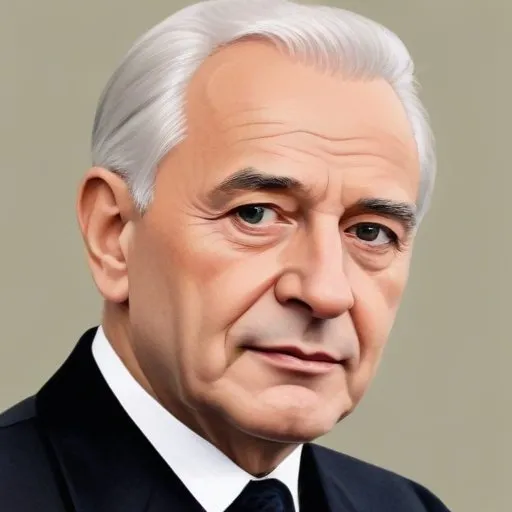
The last communist leader of East Germany, who oversaw the country's transition to democracy and reunification with West Germany in 1990. He played a crucial role in ending the division of Germany.
Hans Modrow, born on January 27, 1928, was a German politician who served as the last communist premier of East Germany, playing a crucial role in the country's transition to democracy. He is known for paving the way for the first free elections in East Germany and collaborating with opposition politicians in his cabinet.
Modrow was born in Jasenitz, Province of Pomerania, German Reich (now Jasienica, Poland). During his youth, he was a Hitler Youth leader and attended a Volksschule. He trained as a machinist from 1942 to 1945 and briefly served in the Volkssturm in January 1945 before being captured by the Soviet Red Army as a prisoner of war.
Modrow's political career began to take shape in the 1960s, and he eventually became a high-ranking official in the Socialist Unity Party (SED). In 1989, he was appointed as the premier of East Germany, a position he held until 1990. His tenure was marked by controversy, including electoral fraud and perjury charges, which he was later convicted of in 1995.
Despite the controversies surrounding his career, Modrow remained a significant figure in German politics. He was the honorary chairman of the Party of Democratic Socialism (PDS) and served as the president of the council of elders of the Left Party from 2007. Modrow passed away on February 10, 2023, leaving behind a complex legacy as a transitional figure in East German history.
Modrow's political ideology was shaped by his experiences in post-war Germany and his involvement with the SED. While his beliefs were often shaped by communist ideology, his later years saw a shift towards democratic socialism.
Modrow's legacy continues to shape modern German politics, serving as a reminder of the country's complex past and its journey towards democracy. His role in paving the way for free elections in East Germany remains a significant milestone in the country's transition.
Born in 1912
The last communist leader of East Germany, known for his rigid adherence to Soviet ideology and his role in constructing the Berlin Wall.
Born in 1913
A German statesman who served as Chancellor of Germany, known for his efforts to reconcile with Eastern Europe and his "Ostpolitik" policy, earning him a Nobel Peace Prize.
Born in 1918
A German leader who served as Chancellor from 1974 to 1982, known for his pragmatic and socially liberal policies, and his key role in shaping the European Union. He was also a respected economist and published author.
Born in 1893
Led the German Democratic Republic (East Germany) from 1950 to 1971, implementing socialist policies and building the Berlin Wall. He's known for his strict communist rule and dividing a nation.
Born in 1914
A German engineer and politician who served as the 4th Prime Minister of East Germany, known for his role in shaping the country's communist government and economy. He played a significant part in the country's Cold War era politics.
89 Years Old
Last communist leader of East Germany, known for his brief rule and attempted reforms before the Berlin Wall fell.
97 Years Old
A journalist and politician who accidentally sparked the fall of the Berlin Wall by prematurely announcing new travel regulations, leading to a wave of protests and eventual reunification.
