


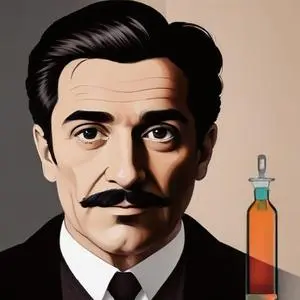
Developed groundbreaking synthetic polymers, revolutionizing plastics and fibers, and was awarded the Nobel Prize in Chemistry in 1963.
Giulio Natta was an Italian chemical engineer and Nobel laureate, best known for his groundbreaking work on high-density polymers, which earned him the Nobel Prize in Chemistry in 1963 alongside Karl Ziegler. His pioneering research on polymer synthesis led to the development of the Ziegler-Natta catalyst, a fundamental breakthrough that transformed the field of polymer chemistry.
Giulio Natta was born on February 26, 1903, in Imperia, Italy. He pursued his degree in chemical engineering from the Politecnico di Milano university in Milan, graduating in 1924. Natta's academic excellence earned him a professorship at the same university, where he taught physical chemistry from 1927 to 1933.
Natta's research focus shifted to crystallography, and he began using it to elucidate the structures of various molecules, including phosphine, arsine, and others. His work at the University of Pavia and later at the University of Rome further solidified his reputation as a leading expert in physical chemistry.
In 1936, Natta became a full professor and director of the Institute of Industrial Chemistry at the Polytechnic Institute of Turin. During this period, he made significant contributions to the development of the Ziegler-Natta catalyst, which enabled the production of high-density polyethylene and other polymers.
Natta's outstanding work earned him numerous accolades, including:
In 1935, Natta married Rosita Beati, a graduate in literature. Rosita was instrumental in coining terms like isotactic, atactic, and syndiotactic for polymers discovered by her husband. The couple had two children, Giuseppe and Franca. Rosita passed away in 1968.
Natta struggled with Parkinson's disease and passed away on May 2, 1979.
Giulio Natta's pioneering work on polymer chemistry continues to influence modern industries, from plastics to textiles. His legacy extends beyond his scientific contributions, as his research paved the way for the development of innovative materials and technologies that transformed daily life.
Natta's story serves as a testament to the power of dedication, perseverance, and collaboration in driving scientific progress and improving human lives.
Born in 1898
Developed groundbreaking catalysts that revolutionized the production of plastics and led to the creation of new materials, earning a Nobel Prize in Chemistry.
Born in 1881
A leading figure in Austrian socialism, he played a key role in shaping the country's post-WWI government and was a prominent advocate for democratic socialism. His writings on Marxism and nationalism remain influential.
Born in 1881
Developed groundbreaking theories on polymers, revolutionizing the field of organic chemistry, and was awarded the Nobel Prize in Chemistry in 1953.
Born in 1860
A pioneer in biochemistry, he discovered that yeast extracts can ferment sugar without living yeast cells, laying the foundation for modern industrial fermentation processes. His work revolutionized the production of beer, wine, and bread.
Born in 1881
Organic chemist and Nobel laureate who synthesized hemin and chlorophyll, leading to a deeper understanding of biological pigments. His work has far-reaching implications for fields like medicine and agriculture.
Born in 1903
A German biochemist and academic who discovered the sex hormones estrogen and testosterone, and was awarded the Nobel Prize in Chemistry in 1939.
Born in 1887
A Croatian-Swiss biochemist and academic who discovered the sex hormones and was awarded the Nobel Prize in Chemistry in 1939 for his work on polymethylenes and higher terpenes. His research laid the foundation for the development of new medicines and insecticides.
Born in 1868
Developed a process to synthesize ammonia, revolutionizing agriculture and warfare, and was awarded the Nobel Prize in Chemistry in 1918.
