


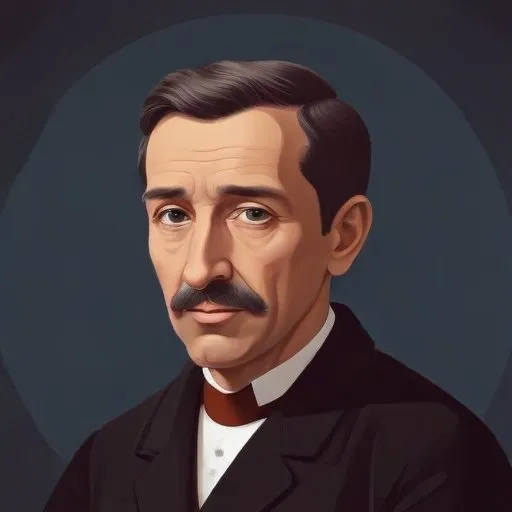
A pioneer in statistics and social physics, he applied mathematical models to understand social phenomena, paving the way for modern sociology and data analysis.
Adolphe Quetelet, a Belgian astronomer, mathematician, statistician, and sociologist, is renowned for introducing statistical methods to the social sciences and founding the science of anthropometry. He is best known for developing the Body Mass Index (BMI) scale, originally called the Quetelet Index, which remains a widely used metric today.
Born on February 22, 1796, in Ghent, which was then part of the French Republic, Quetelet was the son of François-Augustin-Jacques-Henri Quetelet, a Frenchman, and Anne-Françoise Vandervelde, a Flemish woman. His father, a secretary to a Scottish nobleman, traveled extensively throughout Europe, exposing Quetelet to different cultures from a young age.
Quetelet studied at the Ghent Lyce, where he began teaching mathematics in 1815 at the age of 19. He completed his dissertation, De quibusdam locis geometricis, necnon de curva focal, in 1819, earning a doctorate in mathematics from the University of Ghent.
Quetelet's passion for astronomy led him to convince government officials and private donors to build an astronomical observatory in Brussels, which he succeeded in doing in 1828. He became a member of the Royal Academy in 1820 and went on to found and direct the Brussels Observatory.
His work on measuring human characteristics to determine the ideal "l'homme moyen" (average man) played a key role in the origins of eugenics. Quetelet's statistical methods and anthropometric research aimed to identify the average characteristics of a population, which he believed would help improve social and economic conditions.
Quetelet's contributions to statistics, astronomy, and social sciences have had a lasting impact on modern society. His work in anthropometry paved the way for the development of forensic science, and his statistical methods are still used in various fields, including medicine, economics, and social sciences.
Quetelet's legacy extends beyond his scientific contributions. He was a pioneer in applying scientific methods to social issues, leading to a more data-driven approach to policy-making and social reform.
Quetelet's work was influenced by his philosophical belief in the concept of "social physics," which aimed to apply the principles of natural sciences to the study of society. He believed that by understanding the underlying laws governing human behavior, society could be improved through rational planning and policy-making.
Quetelet passed away on February 17, 1874, leaving behind a legacy that continues to influence various fields of study. His work remains a testament to the power of statistical analysis and anthropometric research in understanding and improving human society.
Born in 1749
Developed nebular hypothesis of the origin of the solar system and formulated Laplace's equation, a fundamental concept in mathematics and physics. He's considered the founder of celestial mechanics.
Born in 1777
A pioneer in mathematics and physics, he made major contributions to number theory, algebra, and electromagnetism, shaping our understanding of the natural world.
Born in 1786
A mathematician and politician who made significant contributions to the development of electromagnetism and served as Prime Minister of France, advocating for social reform and education.
Born in 1798
Developed the concept of sociology and coined the term, creating a framework for understanding social structures and relationships. Known for his Positivism philosophy, emphasizing scientific observation and empirical evidence.
Born in 1775
A pioneer in the field of electromagnetism, he formulated fundamental laws that describe the relationship between electric currents and magnetic fields. His work laid the foundation for many modern technologies, including electric motors and generators.
Born in 1774
A French polymath who made significant contributions to the fields of physics, astronomy, and mathematics, particularly in the discovery of chromatic polarization and the Biot-Savart law.
Born in 1768
Developed the Fourier series, a mathematical tool used to decompose periodic functions into their component frequencies, and pioneered the study of heat transfer and thermodynamics.
Born in 1791
Developed the Biot-Savart law, a fundamental principle in electromagnetism, and made significant contributions to the field of psychology.
