


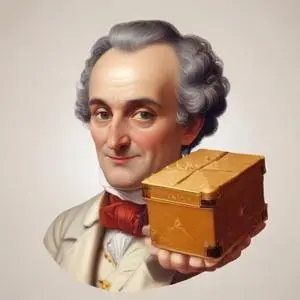
Developed the Fourier series, a mathematical tool used to decompose periodic functions into their component frequencies, and pioneered the study of heat transfer and thermodynamics.
Joseph Fourier, a French mathematician and physicist, is renowned for his groundbreaking work on Fourier series, which laid the foundation for Fourier analysis and harmonic analysis. His contributions have far-reaching implications in various fields, including heat transfer, vibrations, and even the discovery of the greenhouse effect.
Fourier was born on March 21, 1768, in Auxerre, France, to a tailor's family. Orphaned at the age of nine, he was taken under the wing of the Bishop of Auxerre and educated by the Benedictine Order of the Convent of St. Mark.
Fourier's mathematical prowess earned him a military lectureship, and he later became a prominent figure in the French Revolution. He was appointed to the École Normale and subsequently succeeded Joseph-Louis Lagrange at the École Polytechnique.
In 1798, Fourier accompanied Napoleon Bonaparte on his Egyptian expedition as a scientific adviser, where he contributed several mathematical papers to the Egyptian Institute. During this period, he also organized workshops for the French army, ensuring a steady supply of munitions.
Fourier's most notable achievement is the development of the Fourier transform, a mathematical tool that decomposes functions into their constituent frequencies. This innovation has had a profound impact on various fields, including physics, engineering, and signal processing.
In addition, Fourier's law of conduction describes the flow of heat in solids, revolutionizing the understanding of heat transfer and its applications.
Fourier's work was not limited to mathematics and physics. He was also an advocate for social justice and equality, actively participating in the French Revolution. His philosophical beliefs were deeply rooted in the principles of the Enlightenment, emphasizing reason, progress, and human dignity.
Fourier's contributions have had a lasting impact on modern society. His work on the greenhouse effect, although initially overlooked, has become a cornerstone of climate science. The Fourier transform has numerous applications in fields like telecommunications, medical imaging, and data analysis.
In his later years, Fourier predicted the existence of a universal language, which he believed could be derived from mathematical principles. Although this idea was met with skepticism, it highlights Fourier's vision for a unified understanding of the natural world.
Joseph Fourier's legacy extends far beyond his mathematical contributions. He is remembered as a polymath, whose work has influenced fields as diverse as physics, engineering, and social justice.
In recognition of his achievements, the Fourier transform, Fourier's law of conduction, and the crater Fourier on the Moon bear his name.
Through his work, Fourier has left an indelible mark on the scientific community, inspiring generations of mathematicians, physicists, and thinkers.
Born in 1749
Developed nebular hypothesis of the origin of the solar system and formulated Laplace's equation, a fundamental concept in mathematics and physics. He's considered the founder of celestial mechanics.
Born in 1752
Developed the theory of elliptic integrals, and his work on number theory laid the foundation for modern cryptography.
Born in 1777
A pioneer in mathematics and physics, he made major contributions to number theory, algebra, and electromagnetism, shaping our understanding of the natural world.
Born in 1781
Developed mathematical tools to analyze probability and statistics, and made significant contributions to the fields of electricity and magnetism.
Born in 1788
Developed groundbreaking theories on light and wave optics, revolutionizing our understanding of the physical world. His work laid the foundation for modern optics and telecommunications.
Born in 1786
A mathematician and politician who made significant contributions to the development of electromagnetism and served as Prime Minister of France, advocating for social reform and education.
Born in 1774
A French polymath who made significant contributions to the fields of physics, astronomy, and mathematics, particularly in the discovery of chromatic polarization and the Biot-Savart law.
Born in 1785
Developed the Dulong-Petit law, which describes the specific heat capacity of elements, and made significant contributions to the fields of thermodynamics and chemistry.
