


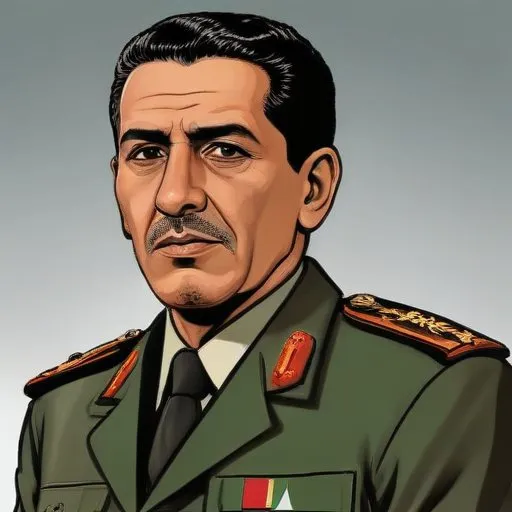
Led Algeria to independence from France, serving as the country's first president and playing a key role in the African independence movement. He's known for his strong anti-colonial stance and socialist policies.
Ahmed Ben Bella, a name synonymous with the Algerian struggle for freedom, was a pioneering politician, soldier, and socialist revolutionary who served as the head of government and the first president of Algeria. He played a pivotal role in the country's war of independence against France, leading the National Liberation Front (FLN) and orchestrating a successful campaign for independence.
Ben Bella was born on December 25, 1916, in the commune of Maghnia, Algeria, to a family of farmers and small-time traders. His father's death during his childhood had a profound impact on his life, and he was forced to drop out of school to support his family. However, this setback did not deter him from pursuing his passion for learning, and he later attended the University of Algiers.
Ben Bella's involvement in the Algerian nationalist movement began in the 1940s, when he joined the Organisation Spéciale (OS), a secret paramilitary organization fighting for independence. His leadership skills and strategic thinking soon propelled him to the forefront of the movement, and he became one of the key figures in the FLN.
In 1954, Ben Bella and his fellow FLN leaders, including Hocine Aït Ahmed and Mohamed Khider, launched the Algerian War of Independence against France. Despite being absent from Algeria during this period, French authorities attempted to assassinate him multiple times, but Ben Bella continued to coordinate the FLN's political strategy from Cairo.
After Algeria gained independence in 1962, Ben Bella's Oujda Group seized power from the provisional government, and he became the prime minister of Algeria, with Ferhat Abbas as acting president. In 1963, he succeeded Abbas as president, winning an election with an overwhelming 99.6% of the votes.
As president, Ben Bella pursued a socialist and pan-Arabist agenda, drawing inspiration from Gamal Abdel Nasser's Egypt and Fidel Castro's Cuba. He nationalized key industries, established good relations with other anti-Zionist Arab states, and implemented progressive social reforms.
However, his presidency was not without controversy. Border clashes with Morocco in 1963, known as the Sand War, and a failed rebellion by the Socialist Forces Front against his regime in 1963-1964, threatened the stability of his government.
In 1965, Ben Bella's Minister of Defense, Houari Boumédiène, orchestrated a coup d'état, and he was ousted from power and placed under house arrest. He remained in detention until 1980, when he was finally released. Ben Bella died on April 11, 2012, at the age of 95.
Ahmed Ben Bella's contribution to Algerian independence and his commitment to socialism and pan-Arabism have earned him a revered place in Algerian history. Despite the challenges and controversies that marked his presidency, his legacy continues to inspire generations of Algerians and Africans, and his name has become synonymous with courage, resilience, and determination.
Ahmed Ben Bella's story is a testament to the power of determination, courage, and vision in shaping the course of history. His legacy continues to inspire and motivate, serving as a reminder of the importance of fighting for freedom, justice, and equality.
89 Years Old
The 5th President of Algeria, a key figure in the country's struggle for independence and a dominant force in its politics for over two decades, known for his role in ending the country's civil war.
Born in 1919
The first president of the Algerian Republic, leading the country to independence from France, and known for his role in the Algerian War and his assassination in 1992.
80 Years Old
The 8th President of Algeria, serving since 2019, known for his efforts to reform the country's political and economic systems, and for his role in navigating the country through a period of significant social unrest.
98 Years Old
A Pakistani politician who served as the Chairman of the Senate of Pakistan from 1994 to 1997, known for his role in the country's political landscape during the 1990s.
