


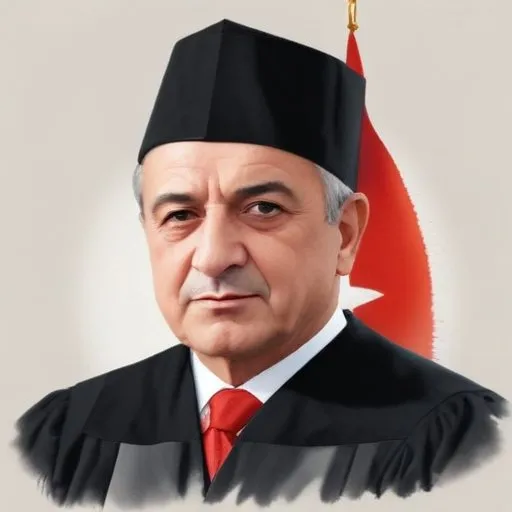
The 10th President of Turkey, a judge-turned-politician who played a crucial role in shaping the country's democratic landscape, known for his commitment to secularism and human rights.
Ahmet Necdet Sezer, the 10th President of Turkey, is renowned for his ardent advocacy of secularism in a country where the lines between religion and state are often blurred. His unwavering stance on this fundamental principle shaped the course of Turkish politics during his presidency from 2000 to 2007.
Sezer was born on September 13, 1942, in Afyonkarahisar, Turkey, to Ahmet Hamdi Sezer and Hatice Sezer, Macedonian Turkish immigrants who fled Greece during the population exchange following the Turkish War of Independence. He pursued higher education at Ankara University, graduating with a degree in law in 1962.
Sezer's illustrious judicial career spanned over three decades, with notable positions including President of the Constitutional Court of Turkey from January 1998 to May 2000. His expertise in constitutional law and his commitment to upholding the principles of democracy earned him widespread respect among his peers.
As President, Sezer became a vocal advocate for secularism, emphasizing its importance in maintaining Turkey's democratic fabric. He vetoed several laws that threatened to blur the lines between religion and state, including banking reforms and the lifting of the political ban on Recep Tayyip Erdogan. His stance on the headscarf issue, prohibiting women who wore it from attending presidential receptions, sparked controversy and highlighted the tensions between secularist and Islamist forces in Turkey.
The 2001 financial crisis, attributed to a combination of factors including the weakness of the coalition government and the large debt owed to the International Monetary Fund, led to a bitter quarrel between Sezer and Prime Minister Bulent Ecevit. This crisis underscored the need for economic reforms and strengthened the opposition's hand in the 2002 general elections.
Ahmet Necdet Sezer's presidency marked a significant turning point in Turkish politics, as his unyielding commitment to secularism underscored the importance of upholding the country's founding principles. His legacy serves as a testament to the enduring power of democratic ideals in the face of adversity.
Ahmet Necdet Sezer's presidency had a profound impact on modern Turkey, as his advocacy for secularism shaped the country's political landscape. His unwavering stance on this issue continues to inspire debate and reflection on the role of religion in Turkish politics.
Sezer's commitment to secularism was rooted in his deep understanding of democracy and the importance of separating religion and state. His philosophical contributions continue to shape Turkey's political discourse, emphasizing the need for a clear distinction between the two.
Ahmet Necdet Sezer's remarkable journey as a statesman, judge, and president has left an indelible mark on Turkey's political history. His unwavering commitment to secularism continues to inspire and challenge future generations of Turkish leaders, ensuring that his legacy remains an integral part of the country's democratic fabric.
72 Years Old
The 12th President of Turkey, a dominant figure in Turkish politics, known for his Islamist roots and authoritarian leadership style, shaping Turkey's modern political landscape.
75 Years Old
The 11th President of Turkey, a politician and academic who played a key role in shaping Turkey's modern politics and foreign policy, known for his efforts to strengthen Turkey's ties with the EU.
Born in 1925
A Turkish journalist, scholar, and politician who served as the 16th Prime Minister of Turkey, known for his progressive policies and literary works. He played a significant role in shaping Turkey's modern politics and culture.
80 Years Old
Served as Prime Minister of Turkey from 2002 to 2014, leading the country through a period of rapid economic growth and implementing significant political reforms. Known for his charismatic leadership and efforts to increase Turkey's global influence.
Born in 1924
A Turkish engineer-turned-politician who served as the country's 9th President, known for his efforts to modernize Turkey's economy and infrastructure. He played a key role in shaping Turkey's politics and economy during the latter half of the 20th century.
99 Years Old
The first Islamist Prime Minister of Turkey, serving from 1996 to 1997, known for his efforts to increase Islamic influence in Turkish politics and society.
