


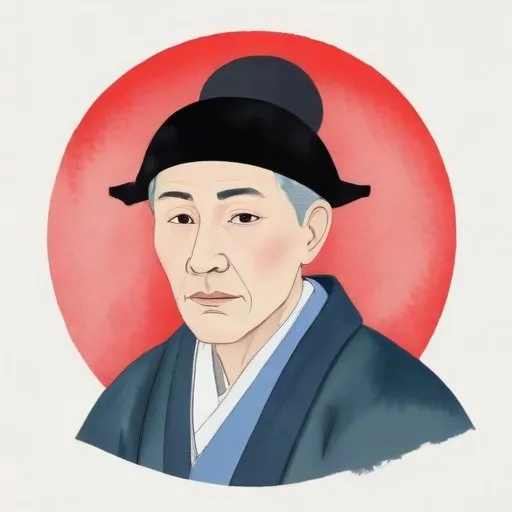
A prominent Chinese poet and author, known for his patriotic and romantic poetry, which often expressed his love for China and its people. His works are considered classics of modern Chinese literature.
Ai Qing, a renowned Chinese poet, painter, and writer, is celebrated for his profound impact on modern Chinese literature and art. Through his poetic works, he voiced the sentiments of a nation, echoing the struggles and aspirations of the Chinese people during a tumultuous period in their history.
Born Jiang Zhenghan on March 27, 1910, in Fantianjiang village, Jinhua county, Zhejiang province, Ai Qing was later known by his pen names Linbi, Kea, and Ejia. His fascination with art and literature led him to attend the Hangzhou Xihu Art School in 1928, where he was encouraged by principal Lin Fengmian to pursue his passion abroad. In 1929, Ai Qing embarked on a journey to Paris, where he was enthralled by the Impressionist masters, such as Renoir and Van Gogh, and immersed himself in the philosophical works of Kant and Hegel.
During his sojourn in France, Ai Qing discovered the works of modern poets like Mayakovsky and was deeply influenced by the Belgian poet Emile Verhaeren. Upon his return to Shanghai in 1932, he joined the China Left Wing Artist Association and was soon arrested for opposing the Kuomintang. During his imprisonment, he translated Verhaeren's poems and penned his first book, Dayanhe (My Nanny), Reed Flute, and Paris. His poetic voice, shaped by his experiences in France and his struggles in China, began to take form.
The outbreak of the Second Sino-Japanese War in 1937 marked a turning point in Ai Qing's life. He wrote Snow Falls on China's Land upon arriving in Wuhan to support the war effort. In 1938, he moved to Guilin, becoming the editor of Guixi Daily newspaper. During this period, he continued to express his feelings about the war and the fate of his nation, solidifying his position as a leading voice in modern Chinese literature.
In 1941, Ai Qing joined the Chinese Communist Party and became the dean of the Chinese department at Chongqing YuCai University. In the subsequent years, he held various positions on cultural committees and edited prominent literary journals, including Poetry Magazine and People's Literature. However, during the Anti-Rightist Movement in 1957, Ai Qing's defense of fellow writer Ding Ling led to his accusation of rightism, and he was exiled to farms in northern China.
Ai Qing's remarkable body of work, spanning over five decades, has left an indelible mark on modern Chinese literature. His poetry, infused with a deep sense of social responsibility and humanitarianism, continues to inspire generations of writers and artists. Despite the controversies he faced, Ai Qing remains a celebrated figure in Chinese cultural history, a testament to the power of art to transcend time and adversity.
Ai Qing received numerous accolades for his contributions to Chinese literature, including the prestigious National Literature Award.
Ai Qing's life is a testament to the enduring power of art and the human spirit. Despite facing persecution, exile, and hardship, he continued to create, inspiring future generations to use their voices to shape the world around them.
Born in 1904
A Chilean poet and diplomat who wrote passionate and evocative poetry that explored love, politics, and the human condition, and was awarded the Nobel Prize in Literature in 1971.
Born in 1914
A Mexican poet and diplomat who won the Nobel Prize in Literature in 1990 for his work that explores the intersection of poetry, philosophy, and politics. He's known for his lyrical and introspective style that explores the human condition.
Born in 1911
A Polish writer and intellectual who explored the human condition, morality, and politics through his novels, essays, and poetry, earning him the Nobel Prize in Literature.
95 Years Old
A Swedish poet, translator, and psychologist who explored the human condition through lyrical and accessible verse, and was awarded the Nobel Prize in Literature in 2011.
