


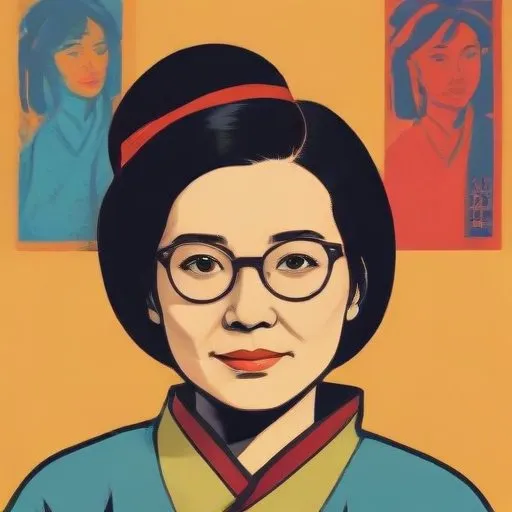
A pioneering female writer and educator who explored themes of feminism, socialism, and individuality in her works, leaving a lasting impact on Chinese literature.
Ding Ling, born Jiang Bingzhi, was a celebrated Chinese author, feminist, and socialist realist writer of the 20th century. She is renowned for her groundbreaking literature that championed women's rights and the struggles of the working class, earning her the prestigious Stalin Prize for Literature in 1951.
Ding Ling was born on October 12, 1904, in Linli, Hunan province, into a gentry family. After her father's untimely death, her mother, Yu Manzhen, raised her as a single parent. Ding Ling's mother, a pioneering educator, instilled in her a strong sense of social responsibility and activism from an early age.
Ding Ling pursued her education in progressive girls' schools in Hunan and Shanghai. She graduated from primary school in 1919 and went on to attend the Hunan Second Normal School, where she developed her writing skills and began to express her feminist ideals.
Ding Ling's writing career spanned over four decades, during which she penned numerous novels, short stories, and essays. Her works often explored themes of social inequality, women's liberation, and the struggles of the working class. Her writing style, characterized by its lyricism and realism, resonated with the Chinese people and solidified her position as a leading literary figure.
In the 1930s, Ding Ling became an active member of the Chinese Communist Party (CCP) and was instrumental in shaping the country's literary landscape. She played a crucial role in establishing the League of Left-Wing Writers, a literary organization that promoted socialist realism and anti-imperialism.
Ding Ling's contributions to Chinese literature were recognized with several prestigious awards. In 1951, she received the Stalin Prize for Literature for her novel The Sun Shines Over Sanggan River, a powerful portrayal of rural life and the struggles of the peasantry.
Despite her literary accomplishments, Ding Ling faced severe persecution during the Anti-Rightist Campaign in 1958. She was denounced, purged, and exiled to Manchuria, where she spent over two decades in obscurity. It wasn't until 1979 that she was rehabilitated and her literary contributions were once again recognized.
Ding Ling's legacy extends far beyond her literary accomplishments. She played a pivotal role in shaping China's literary landscape, inspiring generations of writers and intellectuals. Her unwavering commitment to social justice and women's rights continues to inspire people around the world. Today, Ding Ling is celebrated as a pioneering feminist icon, a testament to the power of literature to transform lives and societies.
Ding Ling's personal life was marked by tragedy and resilience. She married Chen Ming, a fellow writer, in 1928, but their union was short-lived, as Chen Ming died in 1931. Ding Ling's later years were marked by personal struggles, including her exile and rehabilitation. She passed away on March 4, 1986, in Beijing, leaving behind a legacy that continues to inspire and empower people worldwide.
Ding Ling's remarkable life and literary contributions serve as a testament to the transformative power of literature and the importance of standing up for what one believes in, even in the face of adversity. Her legacy continues to inspire generations of readers, writers, and social activists, cementing her place as one of the most celebrated Chinese authors of the 20th century.
Born in 1009
A renowned poet and essayist of the Song Dynasty, known for his lyrical and expressive writings that explored themes of nature, politics, and human emotions.
Born in 1893
Leader of the Chinese Communist Party who implemented radical social and economic reforms, including the Great Leap Forward and the Cultural Revolution, shaping modern China's politics and economy.
Born in 1898
The first Premier of the People's Republic of China, serving from 1949 until his death in 1976, is most known for his key role in the Chinese Communist Party and his diplomatic efforts to improve relations with the West. He played a crucial part in shaping China's foreign policy and economy during a pivotal period in the country's history.
Born in 1898
A prominent military leader who played a crucial role in the Chinese Civil War and later became a key figure in the Communist Party, known for his criticisms of Mao's policies. He was eventually purged and persecuted during the Cultural Revolution.
Born in 1896
A prominent Chinese military leader and politician who played a key role in the Chinese Civil War and later served as the 1st Vice Premier of the People's Republic of China, known for his efforts in modernizing the Chinese military. He was a close ally of Mao Zedong and helped establish the People's Liberation Army.
Born in 1904
A Chinese revolutionary and statesman who led the country's economic reforms, transforming it into a global superpower. He's credited with opening up China to the world and introducing capitalist principles.
Born in 1886
A prominent Chinese military leader and politician who played a crucial role in the Chinese Civil War and the establishment of the People's Republic of China, serving as the second-in-command to Mao Zedong. He's most known for his military strategies and leadership during the war.
