


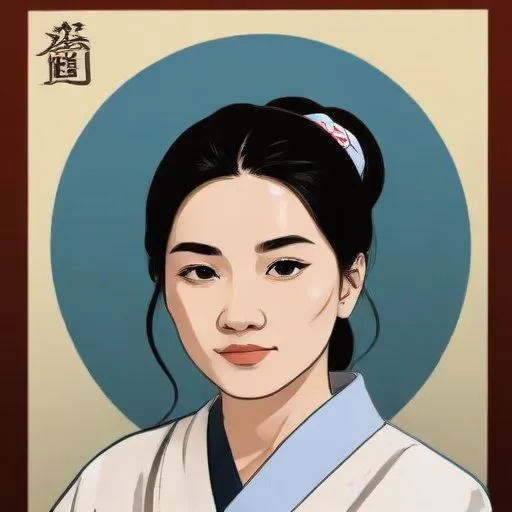
A renowned poet and essayist of the Song Dynasty, known for his lyrical and expressive writings that explored themes of nature, politics, and human emotions.
Su Xun was a renowned Chinese scholar, essayist, and philosopher of the Song Dynasty, celebrated as one of the Eight Masters of the Tang and Song. He is particularly esteemed for his eloquent writings, which encapsulated his insightful views on politics, economy, and military reforms, earning him recognition as a leading literati of his time.
Su Xun was born on May 22, 1009, in Meishan, Sichuan Province, to an affluent family. He began his academic pursuit at the age of 27, dedicating himself to the civil service examination. Despite repeated attempts, he failed to secure the Jinshi and Maocai Xiucai qualifications, prompting him to reassess his approach.
At 37, Su Xun shifted his focus from examination-style writings, which emphasized rhythm and formality, to an intensive study of classical literature and philosophy from the pre-Qin era. This decade-long journey of self-discovery enabled him to acquire a profound understanding of classic scholarly discourses and historical events.
In 1056, Su Xun, accompanied by his sons Su Shi and Su Zhe, traveled to the capital Bianjing to meet the Hanlin academician Ouyang Xiu. He presented twenty-two essays, showcasing his recommendations and insights on political, economic, and military reforms. Ouyang Xiu was deeply impressed by Su Xun's literary style, likening it to that of the ancient Confucian philosopher Xunzi.
Su Xun's writings quickly gained popularity among scholars and officials in the capital, who eagerly read and emulated his works. His fame was further solidified when his sons, Su Shi and Su Zhe, passed the imperial examination with high scores in 1057, creating a sensation in the capital.
Su Xun's life was not without its challenges. In 1058, his wife, Lady Cheng, passed away, casting a profound shadow of grief over the family. This personal loss, however, did not deter Su Xun from continuing to share his wisdom with the world.
Su Xun's philosophical contributions were deeply rooted in his study of classical literature and philosophy. He believed in the importance of self-cultivation, emphasizing the need for individuals to cultivate their moral character and strive for personal growth. His writings often explored the complexities of human nature, politics, and governance, offering insightful commentary on the role of education in shaping society.
Su Xun's enduring legacy lies in his profound impact on Chinese literature and philosophy. His eloquent writings continue to inspire and educate scholars, officials, and readers alike, serving as a testament to the power of education and personal growth. His emphasis on moral character, self-cultivation, and education has had a lasting influence on Chinese thought and culture, shaping the country's intellectual and social landscape.
Su Xun's unique blend of philosophical insight, literary elegance, and historical understanding sets him apart from his contemporaries. His writings, while rooted in traditional Chinese thought, demonstrate a innovative and forward-thinking approach, earning him recognition as a true intellectual giant of the Song Dynasty.
"The way of the superior man is threefold, virtuous, they are free from anxieties; wise, they are free from perplexities; bold, they are free from fear."
This quote, taken from one of Su Xun's essays, encapsulates his philosophical emphasis on moral character, self-cultivation, and personal growth.
Su Xun's remarkable life serves as a testament to the transformative power of education and personal growth. His unwavering dedication to his craft, despite facing numerous setbacks, is a powerful motivator for anyone seeking to make a positive impact on the world.
Through his life and writings, Su Xun reminds us that education is not solely about acquiring knowledge, but about cultivating our moral character and striving for personal growth. His legacy continues to inspire generations, offering a profound reminder of the enduring power of education and self-cultivation.
Born in 1009
A renowned poet and essayist of the Song Dynasty, known for his lyrical and expressive writings that explored themes of nature, politics, and human emotions.
Born in 1868
A pioneering educator and reformer who transformed China's education system and promoted academic freedom, known for his advocacy of democracy and human rights.
Born in 1885
A pioneering Chinese writer and translator, known for introducing Western literature to China and promoting cultural exchange through his translations and essays.
Born in 1892
A prominent Chinese intellectual who made significant contributions to the country's cultural and literary heritage through his historical writings, poetry, and plays. He's also known for his role in shaping modern Chinese literature and language.
