


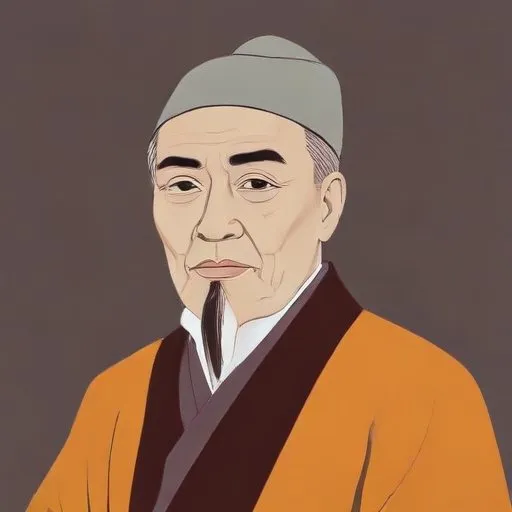
A prominent Chinese intellectual who made significant contributions to the country's cultural and literary heritage through his historical writings, poetry, and plays. He's also known for his role in shaping modern Chinese literature and language.
Guo Moruo, also known as Dingtang, was a Chinese author, poet, historian, archaeologist, and government official who left an indelible mark on Chinese literature and culture. He is perhaps best known for his influential works on Chinese history and his contributions to the development of modern Chinese literature.
Guo Moruo was born on November 16, 1892, in the small town of Shawan, Sichuan Province. His family had a rich cultural heritage, with his ancestors being Hakkas from Ninghua County in Tingzhou Prefecture. His father, Guo Mingxing, was a successful businessman and doctor who valued education, which had a profound impact on Guo Moruo's early life.
Guo Moruo's education began at a traditional Confucian private school, where he studied classical Chinese literature and history. He later attended the prestigious Sichuan Higher School, where he developed an interest in Western literature and philosophy.
Guo Moruo's literary career spanned several decades, during which he wrote numerous works on Chinese history, literature, and culture. His most notable works include The Goddesses, a collection of poems that celebrated the beauty of Chinese mythology, and The Ancient Chinese Literature, a comprehensive study of Chinese literary history.
Guo Moruo's writing style was known for its lyricism, depth, and historical accuracy, which earned him recognition as one of the most influential writers of modern Chinese literature. His works not only reflected his deep understanding of Chinese culture but also his ability to adapt Western literary techniques to the Chinese context.
Guo Moruo was deeply interested in philosophy and was influenced by Marxist thought. He believed that literature should serve the people and promote social change. His philosophy was reflected in his writing, which often explored themes of social justice, equality, and humanism.
Guo Moruo's philosophical contributions extended beyond literature to politics and education. He played a key role in the development of modern Chinese education, advocating for reforms that emphasized critical thinking, scientific inquiry, and cultural heritage.
Guo Moruo's government career began in the 1920s, when he served as the Director of the Institute of History and Philology at the Sichuan Provincial Museum. He later became the Vice Minister of Education and the President of the Chinese Academy of Sciences.
Guo Moruo's legacy extends beyond his literary and philosophical contributions. He played a crucial role in promoting cultural exchange between China and the world, and his efforts helped to establish China as a major player in international academia.
Guo Moruo's impact on modern Chinese literature and culture is immeasurable. His contributions to education, philosophy, and literature have inspired generations of scholars, writers, and thinkers. As a true Renaissance man, Guo Moruo continues to inspire and educate, leaving behind a legacy that will be cherished for centuries to come.
Born in 1893
Leader of the Chinese Communist Party who implemented radical social and economic reforms, including the Great Leap Forward and the Cultural Revolution, shaping modern China's politics and economy.
Born in 1898
The first Premier of the People's Republic of China, serving from 1949 until his death in 1976, is most known for his key role in the Chinese Communist Party and his diplomatic efforts to improve relations with the West. He played a crucial part in shaping China's foreign policy and economy during a pivotal period in the country's history.
73 Years Old
A renowned Chinese violinist and composer, blending Eastern and Western musical styles, creating a unique sound that showcases cultural fusion.
Born in 1898
A prominent military leader who played a crucial role in the Chinese Civil War and later became a key figure in the Communist Party, known for his criticisms of Mao's policies. He was eventually purged and persecuted during the Cultural Revolution.
Born in 1907
A powerful Chinese military leader and politician who rose to prominence during the Chinese Civil War and later became a close ally of Mao Zedong, playing a crucial role in the Cultural Revolution. He is infamous for his alleged plot to overthrow Mao and his mysterious death in a plane crash.
Born in 1904
A Chinese revolutionary and statesman who led the country's economic reforms, transforming it into a global superpower. He's credited with opening up China to the world and introducing capitalist principles.
Born in 1886
A prominent Chinese military leader and politician who played a crucial role in the Chinese Civil War and the establishment of the People's Republic of China, serving as the second-in-command to Mao Zedong. He's most known for his military strategies and leadership during the war.
