


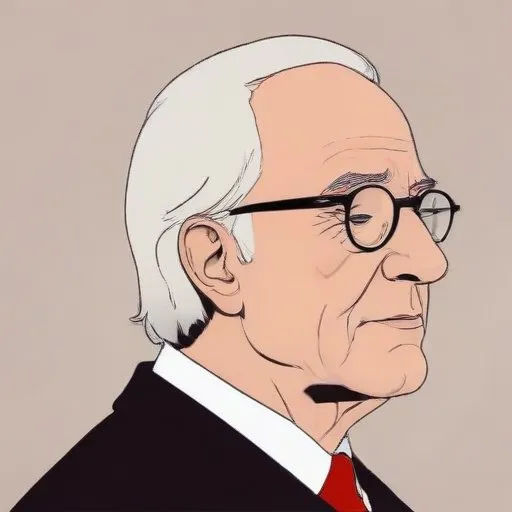
A French scholar and politician who served as Minister of Justice, known for his efforts to reform the French justice system and his writings on sociology and politics.
Alain Peyrefitte, a French scholar and politician, is best known for his influential role as a confidant to Charles de Gaulle and his long-standing career in public service. Known for his bold stances, Peyrefitte's support for partitioning Algeria during the Algerian War remains a defining aspect of his legacy.
Born on August 26, 1925, Peyrefitte's early life was shaped by his education at the École Normale Supérieure and later at the École Nationale d'Administration. These institutions laid the foundation for his future career in politics and diplomacy.
Peyrefitte's extensive career in public service spanned multiple countries, including Germany and Poland, where he served as a diplomat. His roles in government included Secretary of State for Information, Minister of Returnees, Minister of Information, Minister of Scientific Research and Atomic Questions and Space, Minister of Education, Minister for Administrative Reforms, and Minister of Cultural Affairs and the Environment.
Aside from his political career, Peyrefitte was a prolific writer, penning several notable books. Two of his most famous works, The Immobile Empire and Quand la Chine s'éveillera, le monde tremblera, showcased his unique perspective on French and European history. His book Le Mal français, translated to The Trouble with France, has become a seminal work, offering insight into the complexities of the French character and its impact on the country's history.
On December 15, 1986, Peyrefitte survived an assassination attempt by Action Directe, a militant group, in front of his home. Tragically, the driver of his car was killed in the bomb attack. Following his death on November 27, 1999, he was honored with burial in Les Invalides, a prestigious burial ground reserved for France's most revered national leaders.
In 1977, Peyrefitte was inducted into the Académie Française, one of the highest honors in French literature and academia. Throughout his life, he received numerous awards and honors, a testament to his dedication to public service and his literary contributions.
Alain Peyrefitte's life was a testament to his dedication to public service, literature, and French history. His legacy continues to influence French politics and intellectual discourse, solidifying his place as one of France's most respected statesmen.
Born in 1916
A French lawyer and politician who served as the 21st President of France, known for his socialist policies and role in shaping the European Union. He's also remembered for his controversial past and complex personality.
93 Years Old
A French military officer and statesman who served as President of France from 1995 to 2007, known for his opposition to the US-led invasion of Iraq and his efforts to strengthen the European Union.
71 Years Old
The 23rd President of France, a lawyer-turned-politician who led the country from 2007 to 2012, known for his efforts to reform the EU and his controversial domestic policies.
71 Years Old
The 24th President of France, a key European leader who implemented significant economic reforms and played a crucial role in shaping the European Union's policies, particularly during the European sovereign-debt crisis.
Born in 1840
A pioneering figure in naturalist literature, known for his influential novels that exposed social ills and championed reform, such as "Germinal" and "Nana".
Born in 1905
Existentialist philosopher and playwright who argued that humans have complete freedom to choose their actions and create their own meaning in life, influencing modern thought on morality and individual responsibility.
Born in 1908
A pioneering feminist philosopher who wrote extensively on ethics, politics, and gender, famously arguing that "one is not born, but rather becomes, a woman."
Born in 1901
A French historian, theorist, and author who wrote influential novels and essays on art, politics, and human condition, exploring the complexities of modern society.
