


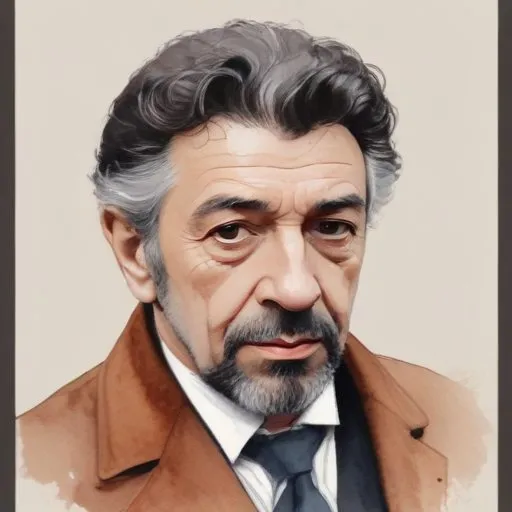
French New Wave pioneer behind avant-garde films and novels that blurred lines between reality and fiction, exploring themes of identity, memory, and human psyche. Known for his unconventional narrative styles and philosophical depth.
Alain Robbe-Grillet was a French writer and filmmaker who revolutionized the literary world with his groundbreaking novels, scripts, and films, earning him a reputation as one of the most prominent figures of the Nouveau Roman movement of the 1960s.
Robbe-Grillet's innovative approach to literature challenged traditional notions of storytelling, character development, and narrative structure. His works, such as The Erasers and La Jalousie, discarded conventional plot devices, opting instead for a more experimental, fragmented, and introspective style.
Born on August 18, 1922, in Brest, France, Robbe-Grillet was raised in a family of engineers and scientists. His early years were marked by a strong interest in mathematics and science, which later influenced his analytical and precise writing style.
During World War II, Robbe-Grillet was forced to participate in compulsory labor in Nuremberg, Germany, where he worked as a machinist. This experience had a profound impact on his worldview and writing, as he often incorporated themes of existentialism, alienation, and the absurd.
Robbe-Grillet's first published novel, The Erasers, appeared in 1953 and marked the beginning of his literary career. The novel's success was followed by a string of critically acclaimed works, including La Jalousie, The Voyeur, and .
As a literary advisor for Les Éditions de Minuit from 1955 to 1985, Robbe-Grillet played a crucial role in promoting the works of fellow Nouveau Roman writers, such as Michel Butor and Nathalie Sarraute.
In the 1960s, Robbe-Grillet turned to filmmaking, collaborating with acclaimed director Alain Resnais on the script for Last Year at Marienbad. He then went on to write and direct his own films, including The Man Who Lies and Glissements progressifs du plaisir.
Robbe-Grillet's contributions to literature and film were recognized with numerous awards and honors, including the prestigious Académie Française seat No. 32, which he occupied from 2004 until his death in 2008.
Alain Robbe-Grillet's innovative approach to storytelling has left an indelible mark on modern literature and cinema. His influence can be seen in the works of authors and filmmakers such as Jean-Luc Godard, Alain Resnais, and Thomas Pynchon, among many others.
Today, Robbe-Grillet's writings and films continue to inspire new generations of artists, writers, and intellectuals, cementing his place as one of the most important and provocative figures of the 20th century.
Robbe-Grillet's works were not without controversy, with some critics accusing him of excessive intellectualism and abstraction. However, his supporters praised his innovative approach to narrative and his ability to challenge traditional notions of storytelling.
95 Years Old
A pioneer of French New Wave cinema, known for experimental and provocative films that challenged traditional narrative structures and explored themes of politics, philosophy, and social commentary.
94 Years Old
A pioneering filmmaker of the French New Wave, known for directing iconic films like "Jules and Jim" and "The 400 Blows", which redefined cinematic storytelling.
Born in 1920
French New Wave pioneer behind contemplative, visually stunning films that explore human relationships and morality, known for subtle storytelling and nuanced character studies.
96 Years Old
A French New Wave pioneer, known for crafting suspenseful, psychologically complex films that probed the darker aspects of human nature, often focusing on the bourgeoisie.
Born in 1905
Existentialist philosopher and playwright who argued that humans have complete freedom to choose their actions and create their own meaning in life, influencing modern thought on morality and individual responsibility.
Born in 1908
A pioneering feminist philosopher who wrote extensively on ethics, politics, and gender, famously arguing that "one is not born, but rather becomes, a woman."
Born in 1913
A French novelist, philosopher, and journalist who wrote influential works like "The Stranger" and "The Plague", exploring absurdism and the human condition.
Born in 1915
A French philosopher, theorist, and critic who challenged traditional notions of culture, literature, and identity through his influential writings on semiotics, mythology, and structuralism. He's most known for his critical theories on modern society and culture.
