


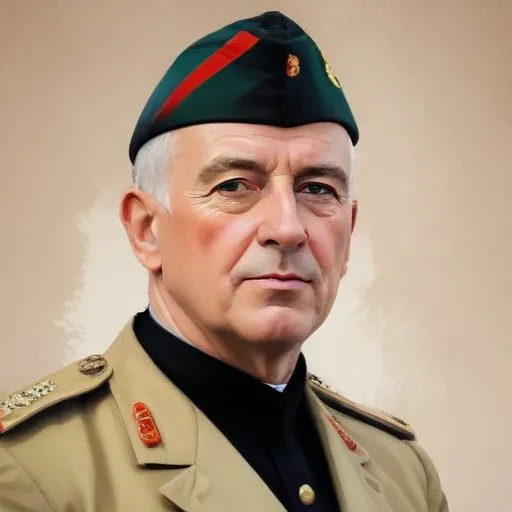
A British Army officer who served as High Commissioner for Palestine and Transjordan during the British Mandate period, known for his role in shaping the region's modern political landscape. He played a crucial part in the establishment of the State of Israel.
General Sir Alan Gordon Cunningham is famously known for leading the British forces to a series of victories over Italian troops in the East African Campaign during World War II. Under his command, the British army successfully recaptured British Somaliland, freed Addis Ababa from Italian occupation, and eventually defeated the Italian forces in Eritrea and Abyssinia.
Born on May 1, 1887, in Dublin, Ireland, Cunningham was the third son of Scottish Professor Daniel John Cunningham and his wife Elizabeth Cumming Browne. He was educated at Cheltenham College and later attended the Royal Military Academy, Woolwich, earning a commission in the Royal Artillery in 1906.
During World War I, Cunningham served with the Royal Horse Artillery and was awarded the Military Cross in 1915 and the Distinguished Service Order in 1918. Following the war, he served as a staff officer in the Straits Settlements for two years.
Cunningham's military career took off in the 1920s and 1930s. He graduated from the Royal Naval College, Greenwich in 1925 and later attended the Imperial Defence College in 1937. He became the Commander, Royal Artillery of the 1st Infantry Division, followed by promotion to Major-General and appointment as commander of the 5th Anti-Aircraft Division in 1938.
In 1940, Cunningham was promoted to Lieutenant-General and appointed commander of the East Africa Force in Kenya. Under his leadership, the British army achieved a series of victories against the Italian forces, eventually leading to the surrender of Italian East Africa in November 1941.
Cunningham's military strategy and tactics played a significant role in the campaign's success. He effectively utilized mobile warfare, rapid advances, and bold maneuvering to outmaneuver the Italian forces, often outnumbered and outgunned.
After the East African Campaign, Cunningham served as the Commander-in-Chief of the Eighth Army in the North African Campaign. Although he was relieved of command during the Crusader battle against Erwin Rommel, he continued to serve in various capacities, including as the High Commissioner of Palestine from 1945 to 1948.
Cunningham retired from active service in 1946 and spent the rest of his life in relative quiet, passing away on January 30, 1983, at the age of 95.
Alan Cunningham's military achievements and leadership during the East African Campaign remain an important chapter in British military history. His victories over Italian forces not only secured a crucial Allied victory but also demonstrated the effectiveness of mobile warfare and the importance of bold leadership.
Cunningham's legacy extends beyond his military achievements. He played a significant role in shaping the modern British army, and his experiences during World War II continue to inform military strategy and tactics to this day.
Born in 1871
Prolific writer of historical novels and adventure stories, also a talented landscape painter.
Born in 1886
The founder of the State of Israel, who played a crucial role in the country's establishment and served as its first prime minister, shaping the nation's early years and policies. He's revered as a national hero and a symbol of Israeli independence.
Born in 1874
A pioneering chemist and statesman who played a key role in establishing the State of Israel and served as its first president, known for his diplomatic efforts and scientific contributions.
Born in 1894
The 2nd Prime Minister of Israel, a key figure in the country's early years, known for his moderate approach to Arab-Israeli relations and efforts to establish diplomatic ties with neighboring countries.
Born in 1898
A pioneering female leader who served as Israel's first and only female Prime Minister, known for her strong leadership during times of war and peace. She played a crucial role in shaping Israel's early years and remains an iconic figure in Israeli politics.
Born in 1922
A renowned Israeli leader and peacemaker who played a crucial role in shaping the country's history and was awarded the Nobel Prize for his efforts towards peace in the Middle East.
Born in 1913
A Belarusian-born Israeli politician who served as Prime Minister of Israel and was awarded the Nobel Peace Prize for his efforts to establish a peace treaty with Egypt. He's known for his strong leadership and commitment to Israeli security.
98 Years Old
The 11th Prime Minister of Israel, a military leader who played a key role in shaping the country's history, known for his controversial yet influential decisions that continue to impact the Middle East.
