


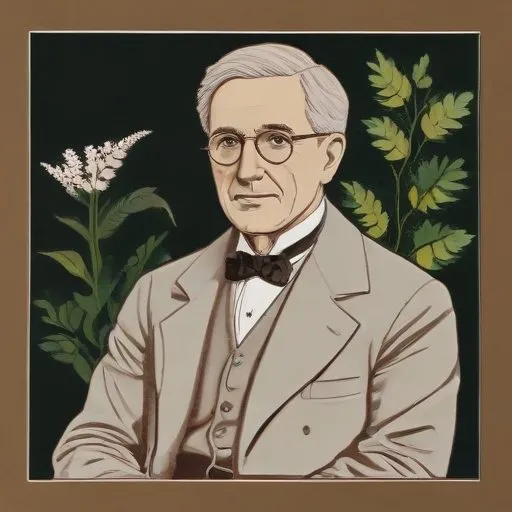
A pioneering botanist who discovered and studied the genetics of plants, particularly the Jimson weed, and made significant contributions to the field of genetics.
Albert Francis Blakeslee is renowned for his groundbreaking research on the poisonous jimsonweed plant and the fascinating realm of fungal sexuality. As a botanist, his work laid the foundation for significant advancements in the field of genetics, paving the way for a deeper understanding of plant and animal development.
Blakeslee was born on November 9, 1874, in Geneseo, New York, to Augusta Miranda Hubbard Blakeslee and Francis Durbin Blakeslee, a Methodist minister. He graduated from Wesleyan University in 1896, where he excelled in sports and academics, winning prizes in mathematics and chemistry.
He went on to earn his master's degree from Harvard University in 1900 and his doctorate in 1904. Blakeslee's academic pursuits also took him to the University of Halle-Wittenberg in Germany, where he studied from 1904 to 1906.
Blakeslee's academic career spanned several institutions, including the Montpelier Seminary in Vermont, the East Greenwich Academy, and the Connecticut Agricultural College (now the University of Connecticut). In 1915, he joined the Carnegie Institution, eventually becoming its director.
In 1941, Blakeslee retired from the Carnegie Institution and returned to academia, accepting a professorship at Smith College. He went on to direct the Smith College Genetics Experimentation Station, where he conducted his seminal research on jimsonweed.
Blakeslee's work on jimsonweed, a plant notorious for its toxicity and pungent odor, led to significant breakthroughs in genetics. By using colchicine to induce polyploidy and aneuploidy in the plant, he opened up new avenues of research into the effects of chromosome manipulation on plant development.
His experiments demonstrated the potential for artificial polyploidy and aneuploidy, sparking a new wave of research in the field. Blakeslee's work on jimsonweed solidified his position as a leading figure in genetics in the early 20th century.
Blakeslee's contributions to botany and genetics have had a lasting impact on our understanding of plant and animal development. His pioneering work on jimsonweed and fungal sexuality has paved the way for further research into the intricacies of genetic manipulation and its applications.
Today, his legacy continues to inspire new generations of scientists and researchers, driving innovation and discovery in the fields of genetics, botany, and beyond.
Blakeslee's outstanding contributions to science were recognized with various awards and honors, including:
Blakeslee's personal life was marked by a deep commitment to his academic pursuits and a passion for sports. He was an avid athlete and remained involved in sports throughout his life.
He was also the brother of George Hubbard Blakeslee, a noted scholar of the Far East.
Albert Francis Blakeslee's remarkable life and career serve as a testament to the power of human curiosity and the importance of scientific inquiry. His groundbreaking research and contributions to the field of genetics continue to inspire and shape our understanding of the natural world.
Born in 1900
A pioneer in evolutionary biology, he integrated genetics and evolution, revolutionizing our understanding of species adaptation and diversity. His work laid the foundation for modern evolutionary theory.
Born in 1895
A prominent literary critic and editor who shaped American literary culture with his insightful essays and reviews, influencing generations of writers and intellectuals.
Born in 1866
Pioneering geneticist who discovered the role of chromosomes in heredity and developed the modern theory of genetics, earning a Nobel Prize in Physiology or Medicine in 1933.
Born in 1893
Discovered the importance of vitamin K in blood clotting, leading to significant advancements in medicine and nutrition.
86 Years Old
Discovered key regulators of the cell cycle, earning a Nobel Prize in Physiology or Medicine in 2001 for his groundbreaking work on the mechanisms that govern cell division. His research has far-reaching implications for cancer treatment and understanding cellular development.
