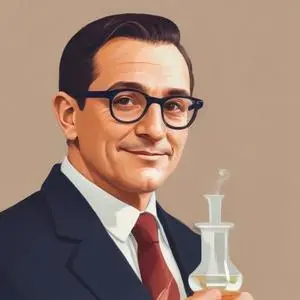
Edward Adelbert Doisy: The Trailblazing Biochemist Behind Vitamin K
A Pioneer in the Realm of Biochemistry
Edward Adelbert Doisy, an American biochemist, left an indelible mark on the scientific community with his groundbreaking discovery of vitamin K, a crucial nutrient for blood clotting. This seminal finding, made in collaboration with
Henrik Dam, earned Doisy the esteemed Nobel Prize in Physiology or Medicine in 1943.
The Formative Years
Born on November 13, 1893, in Hume, Illinois, Doisy's fascination with the intricacies of life led him to pursue higher education at the University of Illinois at Urbana-Champaign, where he secured his A.B. degree in 1914 and M.S. degree in 1916. His academic trajectory continued at Harvard University, where he earned his Ph.D. in 1920.
Acknowledging a Trailblazer's Career
Doisy's illustrious career spanned over four decades, with teaching stints at Washington University in St. Louis and Saint Louis University, where he chaired the Department of Biochemistry. The latter institution would later honor him by renaming the department the E.A. Doisy Department of Biochemistry and Molecular Biology.
Landmark Discoveries
- Doisy's most notable achievement remains the discovery of vitamin K, a crucial nutrient for blood clotting. This breakthrough, achieved in conjunction with Henrik Dam, has had far-reaching implications for human health.
- In 1930, Doisy, along with Adolf Butenandt, independently discovered estrone, a significant milestone in the field of biochemistry.
Doisy's contributions to the scientific community earned him esteemed memberships in:
- The United States National Academy of Sciences (1938)
- The American Philosophical Society (1942)
- The American Academy of Arts and Sciences (1948)
Quotes and Memorable Sayings
Although Doisy's humble nature led him to shy away from the limelight, his work continues to inspire future generations of scientists and researchers.
Historical Context and Legacy
Edward Adelbert Doisy's pioneering work in biochemistry has left an indelible mark on modern medicine. His discovery of vitamin K has saved countless lives, and his contributions to the field continue to shape the course of scientific inquiry.
Did You Know?
- Doisy's Nobel Prize in Physiology or Medicine in 1943 was a milestone achievement, cementing his status as a leading figure in biochemistry.
- In addition to his Nobel Prize, Doisy received numerous accolades, including honorary degrees from institutions such as Washington University and Saint Louis University.
FAQ
What was Edward Adelbert Doisys most notable scientific discovery?
Edward Adelbert Doisys most notable scientific discovery was his identification of the importance of vitamin K in human health, for which he was awarded the Nobel Prize in Physiology or Medicine in 1943.
How did Edward Adelbert Doisys work impact our understanding of nutrition?
Edward Adelbert Doisys work had a profound impact on our understanding of nutrition, highlighting the critical role of vitamins and minerals in maintaining human health.
What was Edward Adelbert Doisys role in the development of biochemistry?
Edward Adelbert Doisy was one of the pioneers of biochemistry, helping to establish it as a distinct field of research and making significant contributions to our understanding of the chemical processes underlying life.
How did Edward Adelbert Doisys American upbringing influence his scientific career?
Edward Adelbert Doisys American upbringing had a significant influence on his scientific career, with access to top-notch research facilities and collaborators contributing to his success.
What were Edward Adelbert Doisys contributions to medical research?
Edward Adelbert Doisy made significant contributions to medical research, including the development of new treatments and therapies based on his discoveries about vitamin K.