


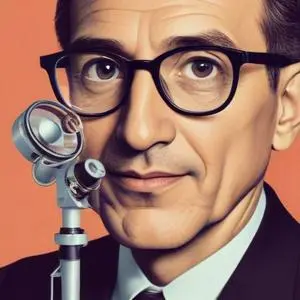
Pioneering biochemist who discovered the mechanism of DNA replication and was awarded the Nobel Prize in Physiology or Medicine in 1959 for his groundbreaking work on nucleic acid synthesis.
Arthur Kornberg, the renowned American biochemist, revolutionized our understanding of DNA synthesis and replication, earning him the Nobel Prize in Physiology or Medicine in 1959. His groundbreaking discovery, made in collaboration with Spanish biochemist Severo Ochoa, unveiled the mechanisms behind the biological synthesis of ribonucleic acid (RNA) and deoxyribonucleic acid (DNA).
Born on March 3, 1918, in New York City, Kornberg was the son of Jewish parents Joseph and Lena Kornberg, who emigrated from Austrian Galicia (now part of Poland) in 1900. His father, Joseph, was a multilingual individual who worked as a sewing machine operator and later owned a small hardware store in Brooklyn, where Arthur assisted customers from a young age.
Kornberg's educational pursuits took him to Abraham Lincoln High School and later to City College of New York, where he earned a B.S. in 1937. He then went on to earn his Doctor of Medicine at the University of Rochester in 1941.
Kornberg's research focus was primarily on biochemistry, particularly enzyme chemistry, DNA synthesis, and the study of nucleic acids controlling heredity in animals, plants, bacteria, and viruses. His work led to the discovery of the first DNA polymerase, an enzyme that synthesizes DNA, and the development of methods for synthesizing DNA in vitro.
Some of his notable contributions include:
Kornberg's outstanding contributions to biochemistry were recognized with numerous awards and honors, including:
Kornberg's personal life was marked by his strong family ties and his passion for research. He married Sylvy Ruth Levy in 1943, and the couple had three children together. Throughout his career, Kornberg was known for his dedication to his work and his ability to inspire and mentor young scientists.
Arthur Kornberg's legacy extends far beyond his own research and discoveries. His work has paved the way for significant advances in molecular biology, genetics, and biotechnology. His contributions have improved our understanding of the fundamental processes of life and have opened up new avenues for the diagnosis and treatment of diseases.
Kornberg's remarkable career and achievements serve as a testament to the power of human curiosity, dedication, and innovation. His story continues to inspire generations of scientists and researchers, cementing his place as one of the most influential scientists of the 20th century.
Born in 1916
Pioneering scientist who discovered the structure of DNA, revolutionizing our understanding of genetics and life itself.
98 Years Old
Discovered the structure of DNA, revolutionizing our understanding of genetics and earning a Nobel Prize. Pioneering work in molecular biology has far-reaching implications for medicine and beyond.
Born in 1920
A British scientist who contributed significantly to the discovery of the structure of DNA, providing high-quality X-ray crystallography images that helped James Watson and Francis Crick develop their famous model.
Born in 1916
A Nobel Prize-winning physicist and biologist who contributed significantly to the discovery of the structure of DNA, using X-ray crystallography to produce the first clear images of the molecule.
Born in 1901
Pioneering chemist and peace activist who won two unshared Nobel Prizes, one for chemistry and one for peace, for his groundbreaking work on the nature of the chemical bond and his tireless efforts to promote nuclear disarmament.
Born in 1850
A Nobel Prize-winning biologist who made groundbreaking discoveries in molecular biology, particularly in understanding the replication of viruses and DNA.
Born in 1925
A pioneering geneticist who discovered bacterial gene recombination and transduction, revolutionizing our understanding of genetic inheritance and earning a Nobel Prize.
