


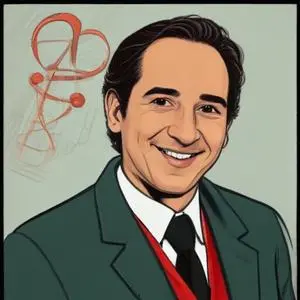
A pioneering biochemist who discovered the mechanism of RNA synthesis, earning a Nobel Prize in Physiology or Medicine in 1959. His work laid the foundation for our understanding of genetic code and protein synthesis.
Severo Ochoa is renowned for his groundbreaking discovery of the mechanisms in the biological synthesis of deoxyribonucleic acid (DNA), earning him the 1959 Nobel Prize in Physiology or Medicine, alongside Arthur Kornberg. This monumental achievement revolutionized our understanding of the fundamental building blocks of life, paving the way for further research and innovation in the field of molecular biology.
Ochoa was born on September 24, 1905, in Luarca, Asturias, Spain, to a family of intellectuals and politicians. His father, Severo Manuel Ochoa, was a lawyer and businessman, while his mother, Carmen de Albornoz, was a homemaker. Following his father's untimely death, Ochoa and his mother moved to Málaga, where he completed his elementary and high school education.
Ochoa's interest in biology was sparked by the works of Spanish neurologist and Nobel laureate Santiago Ramón y Cajal. He pursued his higher education at the University of Madrid Medical School, where he was taught by Juan Negrín, who would later become a significant influence in Ochoa's life. Negrín encouraged Ochoa to explore scientific literature beyond Spanish texts, broadening his perspectives and igniting a passion for research.
Ochoa's research career took off during his summer stint at the University of Glasgow in 1927, where he worked with D. Noel Paton on creatine metabolism. This experience refined his skills and shaped his future research trajectory. Upon returning to Spain, Ochoa collaborated with his colleague, José Valdecasas, to isolate creatinine from urine, developing a method to measure small levels of muscle creatinine.
The breakthrough discovery of DNA synthesis came when Ochoa and Kornberg identified the enzymes responsible for replicating DNA. Their pioneering work revealed the mechanisms by which DNA is synthesized, laying the foundation for modern molecular biology. This groundbreaking research earned them the Nobel Prize in Physiology or Medicine in 1959.
Ochoa's work has had a profound impact on our understanding of the genetic code and its role in life processes. His discovery of DNA synthesis has paved the way for numerous scientific advancements, including genetic engineering, forensic science, and the development of new medical treatments.
Ochoa's contributions to science have left an indelible mark on the field of molecular biology. His commitment to research and discovery has inspired generations of scientists, solidifying his place as one of the most influential figures in the history of DNA research.
Born in 1918
Pioneering biochemist who discovered the mechanism of DNA replication and was awarded the Nobel Prize in Physiology or Medicine in 1959 for his groundbreaking work on nucleic acid synthesis.
Born in 1898
A high-ranking officer in the German Wehrmacht during World War II, known for his involvement in the July 20 plot to assassinate Adolf Hitler.
Born in 1920
A French biologist and geneticist who discovered the mechanism of gene regulation, pioneering the field of molecular biology. He won the Nobel Prize in Physiology or Medicine in 1965 for his work on the genetic control of enzyme synthesis.
Born in 1910
A French biochemist and geneticist who discovered the mechanism of gene regulation, earning a Nobel Prize in Physiology or Medicine in 1965. He's also known for his book "Chance and Necessity," which explores the philosophical implications of modern biology.
Born in 1911
A pioneering chemist who uncovered the secrets of photosynthesis, earning a Nobel Prize for his groundbreaking work on the carbon dioxide assimilation process in plants.
Born in 1920
A British scientist who contributed significantly to the discovery of the structure of DNA, providing high-quality X-ray crystallography images that helped James Watson and Francis Crick develop their famous model.
98 Years Old
Discovered the structure of DNA, revolutionizing our understanding of genetics and earning a Nobel Prize. Pioneering work in molecular biology has far-reaching implications for medicine and beyond.
Born in 1916
Pioneering scientist who discovered the structure of DNA, revolutionizing our understanding of genetics and life itself.
