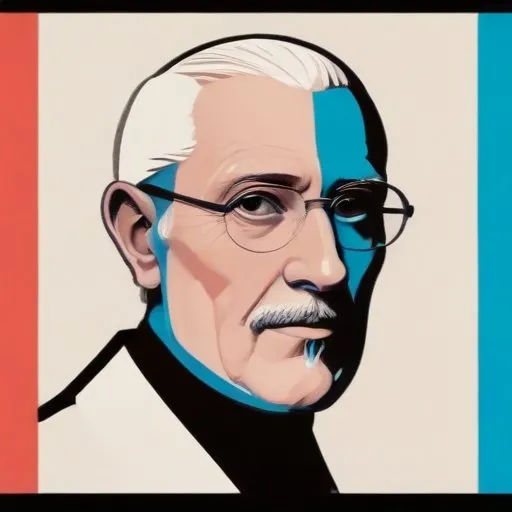
Albert Victor Bäcklund: A Pioneer in Mathematical Transformations
Introduction
Albert Victor Bäcklund, a renowned Swedish mathematician and physicist, is best known for his groundbreaking contributions to the field of contact transformations, particularly the development of the auto-Bäcklund transformation. Born on January 11, 1845, in Malmhus County, Sweden, Bäcklund's work had a profound impact on the understanding of mathematical physics and geometry.
Early Life and Education
Bäcklund's educational pursuits began at the University of Lund in 1861, where he later earned his Ph.D. in 1868. His dissertation, focused on methods for determining the latitude of a place through astronomical observations, showcased his early interest in mathematical physics. This foundation would lay the groundwork for his future research endeavors.
Academic Career and Achievements
Bäcklund's academic career was marked by numerous accomplishments and recognition. In 1878, he was awarded the title of associate professor in Mechanics and Mathematical Physics, and later, in 1888, he was elected Fellow of the Swedish Academy of Science. His travels abroad, supported by a travel grant in 1874, allowed him to work alongside esteemed mathematicians
Felix Klein and
Ferdinand von Lindemann at the universities of Leipzig and Erlangen.
Contributions to Mathematical Physics
Bäcklund's most significant contributions lie in the realm of contact transformations, a field pioneered by
Sophus Lie. His improvements to the understanding of these transformations led to the development of the auto-Bäcklund transformation, a novel concept that has had lasting implications for the field of mathematical physics.
Influence and Legacy
Bäcklund's work has had a profound impact on the development of mathematical physics and geometry. His research has influenced numerous mathematicians and physicists, and his contributions continue to be relevant today. Emily Coddington Williams, a notable translator, has made his work on non-Euclidean geometry accessible to a broader audience.
Personal Milestones and Key Life Events
- 1861: Began studies at the University of Lund
- 1864: Started work at the observatory
- 1868: Earned Ph.D. from the University of Lund
- 1874: Awarded travel grant to study abroad
- 1878: Awarded title of associate professor in Mechanics and Mathematical Physics
- 1888: Elected Fellow of the Swedish Academy of Science
- 1897: Became full professor
- 1907-1909: Served as rector of Lund University
Historical Context and Comparative Analysis
Bäcklund's work must be understood within the context of the late 19th century, a time of significant mathematical and scientific advancements. His contributions, while groundbreaking, were part of a broader movement in the development of mathematical physics and geometry. A comparative analysis with contemporaries, such as Sophus Lie and Felix Klein, highlights Bäcklund's unique approach and innovative spirit.
Conclusion
Albert Victor Bäcklund's legacy is a testament to his dedication to mathematical physics and his innovative approach to contact transformations. His work continues to inspire and influence mathematicians and physicists today, solidifying his place as a pioneer in the field.
FAQ
What were Albert Victor Bäcklunds key contributions to mathematics?
Albert Victor Bäcklund made significant contributions to mathematics, particularly in the fields of differential geometry, topology, and complex analysis. His work on Bäcklund transformations and Bäcklunds theorem remains influential today.
How did Albert Victor Bäcklunds work influence modern physics?
Albert Victor Bäcklunds mathematical discoveries had a profound impact on modern physics, particularly in the development of soliton theory and integrable systems. His work paved the way for advances in quantum mechanics, field theory, and condensed matter physics.
What was Albert Victor Bäcklunds role in Swedish mathematical education?
Albert Victor Bäcklund played a crucial role in shaping Swedish mathematical education, serving as a professor at the University of Uppsala and later at the University of Stockholm. He helped raise the profile of mathematics in Sweden, inspiring future generations of mathematicians and scientists.
How did Albert Victor Bäcklunds research intersect with his interests in philosophy and literature?
Albert Victor Bäcklunds mathematical work was informed by his broader interests in philosophy, literature, and aesthetics. He saw mathematics as a means to explore fundamental questions about reality, beauty, and human understanding, and his research reflected this interdisciplinary approach.
What is Albert Victor Bäcklunds legacy in modern mathematics and physics?
Albert Victor Bäcklunds legacy extends across mathematics and physics, with his work on transformations, topology, and integrable systems remaining essential to contemporary research. His innovative approach to mathematics has inspired generations of scholars, ensuring his continued relevance in modern science.