


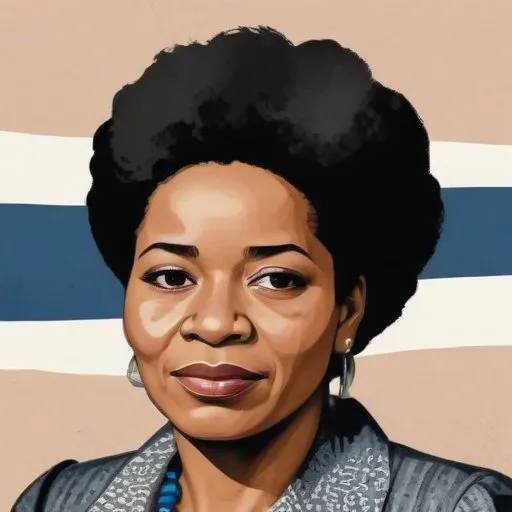
A pioneering figure in the fight against apartheid, known for her fearless activism and dedication to social justice, inspiring generations to stand up against oppression.
Albertina Sisulu, affectionately known as Ma Sisulu, was a South African anti-apartheid activist and a champion of women's rights, who dedicated her life to fighting against the injustices of the apartheid regime. As a member of the African National Congress (ANC) and the founding co-president of the United Democratic Front, she played a pivotal role in the struggle for democracy and equality in South Africa.
Born on 21 October 1918 in the Camama village of the Transkei region, Albertina Sisulu grew up in a Xhosa Mfengu family. Her father, Bonilizwe Thetiwe, was a migrant worker, and her mother, Monica Thetiwe, was disabled by a bout of Spanish flu while pregnant with Albertina. Despite the challenges, Albertina's parents instilled in her a strong sense of determination and resilience.
In 1940, Albertina moved to Johannesburg, where she trained as a nurse and began her journey into politics through her marriage to Walter Sisulu, a prominent anti-apartheid leader. When Walter was imprisoned in the Rivonia Trial, Albertina became increasingly engaged in activism, assuming a prominent role in the establishment of the United Democratic Front (UDF) and the revival of the Federation of South African Women.
Between 1964 and 1989, Albertina was subject to a near-continuous string of banning orders, restricting her movements and freedoms. She was intermittently detained without trial and faced criminal charges on three occasions, including violating pass laws in 1958, the Suppression of Communism Act in 1984, and the Internal Security Act in the 1985 Pietermaritzburg Treason Trial. Despite these challenges, Albertina remained defiant and continued to fight against the apartheid regime.
After the end of apartheid, Albertina represented the ANC in the first democratic Parliament and later retired from politics in 1999. She also served as the deputy president of the ANC Women's League from 1991 to 1993 and a member of the ANC National Executive Committee from 1991 to 1994.
Albertina Sisulu's contribution to the fight against apartheid and her tireless efforts to promote women's rights have earned her numerous honors and recognition. In 1992, she was awarded the Order of Meritorious Service, Class II, by the African National Congress, and in 2004, she received the Order of Luthuli in Gold for her exceptional contribution to the struggle for democracy and human rights.
Albertina Sisulu's life is a testament to the power of courage, resilience, and determination. Her legacy continues to inspire generations of South Africans, and her fight for justice and equality remains an enduring symbol of hope and freedom.
Today, Albertina Sisulu is remembered as a mother of the nation, a champion of women's rights, and a beacon of hope for a generation of South Africans. Her courageous fight against apartheid and her unwavering commitment to democracy and equality have left an indelible mark on the country's history.
Born in 1918
A South African lawyer and politician who fought against apartheid, becoming the country's first black president and a symbol of racial reconciliation, earning a Nobel Peace Prize. He's a beacon of hope and freedom.
Born in 1912
A leading figure in the fight against apartheid, he was a co-founder of the African National Congress and spent 25 years in prison for his activism. He played a key role in shaping South Africa's transition to democracy.
Born in 1917
A leading figure in the fight against apartheid, he served as President of the African National Congress and played a crucial role in mobilizing international opposition to the racist regime.
Born in 1926
A Lithuanian-born South African revolutionary who fought against apartheid, leading the armed wing of the African National Congress and playing a key role in the country's transition to democracy.
97 Years Old
A South African anti-apartheid activist who spent 26 years in prison, including 18 years on Robben Island with Nelson Mandela, fighting for racial equality and democracy.
90 Years Old
A South African anti-apartheid activist and politician who served as the First Lady of South Africa from 1994 to 1996, known for her fight against racial segregation and her controversial yet powerful presence.
84 Years Old
The second President of South Africa, a key figure in the country's transition from apartheid to democracy, known for his economic reforms and HIV/AIDS controversy.
84 Years Old
The 4th President of South Africa, a controversial figure known for his corrupt regime and multiple scandals, including bribery and racketeering charges. He was also a key figure in the fight against apartheid.
