


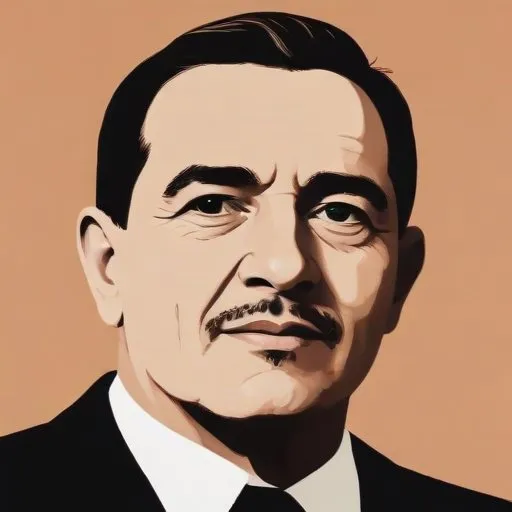
A Swiss-Cuban musicologist and author who explored the intersection of music, culture, and politics in his work, blending magical realism with historical narratives. He's most known for his influential novels that shaped the Latin American literary boom.
Alejo Carpentier, a Cuban novelist, essayist, and musicologist, left an indelible mark on Latin American literature during its famous boom period. He is famously known for introducing the concept of "lo real maravilloso" (the marvelous real), which later became synonymous with magical realism.
Born on December 26, 1904, in Lausanne, Switzerland, to French and Russian parents, Carpentier grew up in Havana, Cuba. Despite his European birthplace, he strongly identified as Cuban throughout his life. His upbringing in Cuba exposed him to the rich cultural heritage of the island, which would later become a significant influence on his writing.
Carpentier's travels took him to France, South America, and Mexico, where he met prominent members of the Latin American cultural and artistic community. He was drawn to revolutionary movements, particularly Fidel Castro's Communist Revolution in Cuba in the mid-20th century. His leftist political philosophies led to his imprisonment and exile.
With a developed knowledge of music, Carpentier published an in-depth study of Cuban music, Carpentier's 1949 novel, Carpentier's writing style integrated the resurgent Baroque style, or New World Baroque style, which Latin American artists adopted from the European model and assimilated to the Latin American artistic vision. This unique blend of styles has had a lasting impact on Latin American literature. Alejo Carpentier's work has inspired generations of writers, including Gabriel García Márquez and Isabel Allende. His innovative approach to storytelling and his ability to capture the essence of Latin American culture have cemented his place as one of the most important figures in Latin American literature. Carpentier received numerous awards for his contributions to literature, including the Cervantes Prize in 1977. His work continues to inspire and influence writers, musicians, and artists around the world. Alejo Carpentier's writing reflects his deep understanding of the complexities of human nature, history, and culture. His work embodies a profound sense of wonder, curiosity, and social awareness, inspiring readers to question and challenge the status quo.The Kingdom of this World and Magical Realism
Baroque Style and Latin American Artistic Vision
Legacy and Impact
Notable Works
Awards and Honors
Philosophical Contributions and Beliefs
Born in 1853
A Cuban journalist, poet, and theorist who led the Cuban independence movement against Spanish rule and is revered as a national hero, known for his literary and philosophical works.
Born in 1867
A leading figure in the Spanish-American literary movement, Modernismo, known for his innovative and influential poetry that explored themes of identity, politics, and culture.
Born in 1864
A Spanish philosopher and author who explored the human condition, faith, and the search for meaning in life, creating influential works that continue to resonate with readers today.
Born in 1898
A Spanish poet, playwright, and director who explored themes of love, death, and Spanish culture through his works, including the famous play "Blood Wedding".
Born in 1904
A Chilean poet and diplomat who wrote passionate and evocative poetry that explored love, politics, and the human condition, and was awarded the Nobel Prize in Literature in 1971.
Born in 1899
A visionary writer who crafted intricate, philosophical tales that blurred reality and fantasy, influencing generations of authors and thinkers. 82
Born in 1914
A pioneering figure in magical realism, blending fantastical elements with everyday life in his novels and short stories, exploring the human condition and social commentary.
