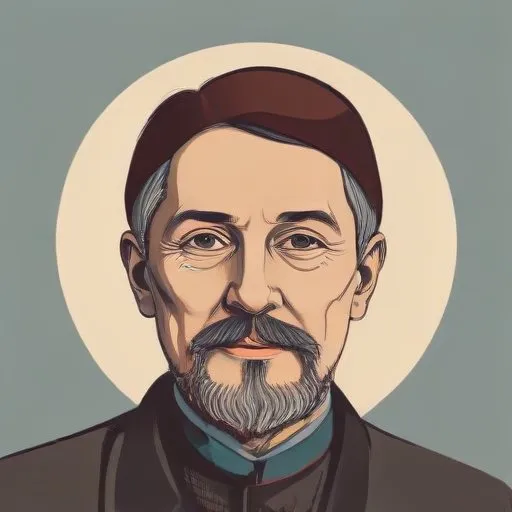
Aleksandr Gennadievich Kurosh: The Architect of Algebraic Geometry
Aleksandr Gennadievich Kurosh, a Soviet mathematician, left an indelible mark on the realm of algebraic geometry. His groundbreaking contributions to the field of mathematics earned him a revered reputation, as he is most notably known for developing the theory of algebraic curves.
A Life of Numbers and Geometry
Born on January 19, 1908, in Yartsevo, Russia, Kurosh's fascination with mathematics began at an early age. He pursued his passion at Moscow University, where he earned his Ph.D. in 1936. Under the guidance of esteemed mathematicians, such as
Dmitry Fomin and Ivan Vinogradov, Kurosh's research flourished.
Theory of Algebraic Curves
Kurosh's magnum opus, the theory of algebraic curves, revolutionized the field of algebraic geometry. He introduced the concept of algebraic curves as Algebraic Function Fields, which enabled the application of algebraic methods to geometric problems. This profound contribution paved the way for significant advances in algebraic geometry, number theory, and computer science.
Philosophical Contributions and Beliefs
Kurosh's work was deeply rooted in his philosophical approach to mathematics. He believed that mathematical structures are not merely abstractions, but rather, they mirror the underlying harmony of the universe. This perspective guided his research, as he sought to unveil the intrinsic beauty of mathematical concepts.
Career Highlights and Major Works
- 1936: Earned Ph.D. from Moscow University
- 1940s: Developed the theory of algebraic curves as Algebraic Function Fields
- 1950s: Published seminal works on algebraic geometry, including "The Theory of Groups" and "Algebraic Curves"
- 1960s: Focused on the application of algebraic geometry to computer science and coding theory
Influence on Modern Society
Kurosh's work has had a profound impact on modern society, with far-reaching applications in:
- Cryptography: Algebraic curves are used in secure data transmission and encryption protocols
- Computer Science: Theoretical foundations of computer science are rooted in Kurosh's work on algebraic geometry
- Code Theory: Error-correcting codes, crucial in digital communication, rely on algebraic curves
Personal Milestones and Key Life Events
- 1944: Elected as a Corresponding Member of the Soviet Academy of Sciences
- 1958: Elected as a Full Member of the Soviet Academy of Sciences
- 1966: Awarded the Lenin Prize for his contributions to mathematics
Legacy and Impact
Aleksandr Gennadievich Kurosh's legacy extends beyond his mathematical contributions. He inspired generations of mathematicians and scientists, leaving an indelible mark on the world of algebraic geometry. As we continue to navigate the complexities of modern technology, Kurosh's work remains a testament to the power of human ingenuity and mathematical beauty.
As Kurosh once aptly stated, "The beauty of mathematics lies not in its theorems, but in the harmony of its structures."
In Memoriam
Aleksandr Gennadievich Kurosh passed away on May 18, 1971, leaving behind a rich mathematical heritage. His work continues to inspire and shape the world of mathematics, a testament to the enduring power of his contributions.
FAQ
What was Aleksandr Gennadievich Kuroshs contribution to Russian mathematics?
Aleksandr Gennadievich Kurosh was a Russian mathematician and theorist who made significant contributions to Russian mathematics, particularly in the field of abstract algebra. He was known for his work on group theory and its applications to geometry and topology.
What is Aleksandr Gennadievich Kuroshs most famous mathematical work?
Aleksandr Gennadievich Kuroshs most famous mathematical work is his development of the theory of free groups, which has had a profound impact on modern algebra and geometry.
What was Aleksandr Gennadievich Kuroshs role in the development of Soviet mathematics?
Aleksandr Gennadievich Kurosh played a significant role in the development of Soviet mathematics, particularly in the 1950s and 1960s. He was a key figure in the establishment of the Moscow Mathematical Society and mentored many prominent mathematicians.
What awards did Aleksandr Gennadievich Kurosh receive for his mathematical work?
Aleksandr Gennadievich Kurosh received several awards for his mathematical work, including the USSR State Prize in 1951 and the Lobachevsky Prize in 1966.
How did Aleksandr Gennadievich Kuroshs experiences in World War II influence his mathematical work?
Aleksandr Gennadievich Kuroshs experiences in World War II had a significant impact on his mathematical work. His experiences as a soldier influenced his focus on abstract algebra and its applications to real-world problems.