


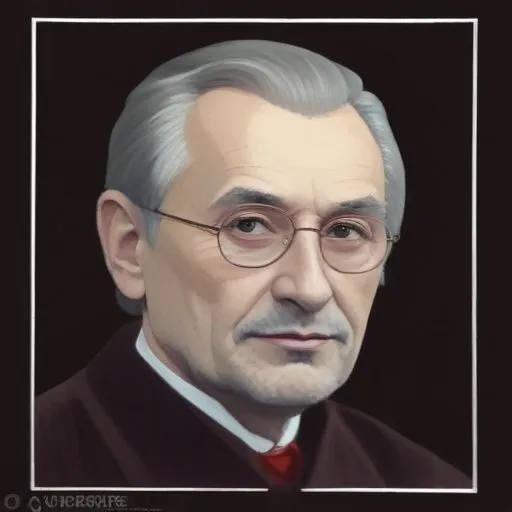
A prominent mathematician and academic who made significant contributions to the development of differential geometry and topology, and was a key figure in the Moscow Mathematical Society.
Dmitri Egorov was a renowned Russian and Soviet mathematician who made significant contributions to the areas of differential geometry and mathematical analysis. He is particularly known for his work on potential surfaces and triply orthogonal systems, which have had a lasting impact on the field of mathematics.
Dmitri Egorov was born on December 22, 1869, in Russia. He developed a strong interest in mathematics from an early age and went on to pursue his passion at the University of Moscow. After completing his studies, Egorov began his career as a mathematician and quickly made a name for himself in the academic community.
Egorov held several leadership roles throughout his career, including President of the Moscow Mathematical Society from 1923 to 1930. He was also the director of the Institute for Mechanics and Mathematics at Moscow State University and edited the journal Matematicheskii Sbornik of the Moscow Mathematical Society.
Egorov held spiritual beliefs to be of great importance and openly defended the Russian Orthodox Church against Marxist supporters after the Russian Revolution. His strong convictions eventually led to him being dismissed from the Institute in 1929 and publicly rebuked.
In 1930, Egorov was arrested and imprisoned as a religious sectarian. He began a hunger strike until he was taken to the prison hospital, and eventually to the house of fellow mathematician Nikolai Chebotaryov, where he died on September 10, 1931. He was later buried in Arskoe Cemetery in Kazan.
Dmitri Egorov's contributions to mathematics have had a lasting impact on the field. His work on differential geometry and mathematical analysis paved the way for future generations of mathematicians. Egorov's Theorem remains a fundamental result in real analysis and integration theory, and his influence can be seen in the work of many prominent mathematicians who followed in his footsteps.
Through his courage and convictions, Egorov inspired countless individuals, and his legacy continues to inspire and motivate mathematicians to this day.
Born in 1903
Developed theories on probability, topology, and complexity, making significant contributions to modern mathematics and computer science.
Born in 1908
Developed the theory of distributions, a fundamental concept in mathematics, and made significant contributions to the fields of calculus, functional analysis, and partial differential equations.
Born in 1856
Developed the theory of Markov chains, a mathematical system that undergoes transitions from one state to another, and is widely used in computer science, biology, and economics.
Born in 1883
A renowned mathematician who developed descriptive set theory and made significant contributions to topology, function theory, and number theory, leaving a lasting impact on modern mathematics.
Born in 1864
A Russian mathematician and physicist who made significant contributions to the development of mathematical physics, particularly in the fields of differential equations and theoretical mechanics.
Born in 1908
A renowned mathematician who made significant contributions to topology, algebra, and differential equations, particularly in the development of Pontryagin duality and Pontryagin classes.
