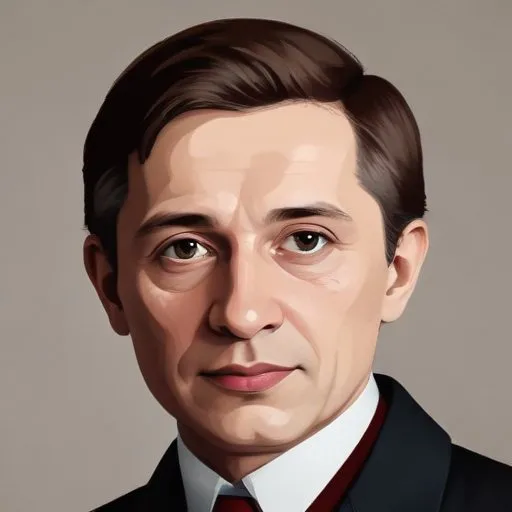
Sergei Sobolev: The Mathematical Visionary Behind Sobolev Spaces
A Pioneering Mind in Mathematical Analysis
Sergei Lvovich Sobolev, a renowned Soviet mathematician, is best known for his groundbreaking contributions to mathematical analysis and partial differential equations, particularly the introduction of Sobolev spaces. These fundamental concepts have far-reaching implications in functional analysis, greatly expanding the scope of mathematical applications.
Early Life and Education
Born on October 6, 1908, in St. Petersburg, Russia, Sobolev was the son of Lev Alexandrovich Sobolev, a lawyer, and Natalya Georgievna. As his city underwent name changes to Petrograd and later Leningrad, Sobolev pursued his passion for mathematics at Leningrad University, graduating in 1929. Under the guidance of Professor Nikolai Gnther, Sobolev laid the foundation for his future accomplishments.
Academic Career and Contributions
Sobolev's academic career was marked by various significant milestones. He worked with Vladimir Smirnov, whom he considered his second teacher, and later joined the Steklov Mathematical Institute in Moscow in 1934. During World War II, he headed the institute in evacuation to Kazan, demonstrating his leadership skills. As a professor of mathematics at Moscow State University (1935-1957) and deputy director of the Institute for Atomic Energy (1943-1957), Sobolev played a crucial role in the Abomb project of the USSR.
Sobolev's most notable contribution is the introduction of Sobolev spaces, which revolutionized the field of functional analysis. His work on generalized functions, later known as distributions, paved the way for the development of the theory of distributions, now considered the calculus of the modern epoch.
Pioneering Work in Computing and Education
In 1958, Sobolev collaborated with Nikolay Brusentsov to develop the ternary computer Setun, a pioneering achievement in computer science. His involvement in proposing a large-scale scientific and educational initiative for the Eastern parts of the Soviet Union led to the creation of the Siberian Division of the Academy of Sciences, further solidifying his impact on the academic community.
Legacy and Impact
Sobolev's work has had a profound influence on modern mathematics, with his concepts and theories continuing to shape research and applications. His contributions to functional analysis, partial differential equations, and computer science have made him a legend in the mathematical community. As a testament to his legacy, Sobolev spaces remain a fundamental area of study, and his work on distributions continues to inspire new generations of mathematicians.
Awards and Honors
- Member of the Academy of Sciences of the USSR (1946)
- Hero of Socialist Labour (1956)
Personal Life and Milestones
While Sobolev's professional accomplishments are well-documented, his personal life remains somewhat enigmatic. Despite this, it is clear that his dedication to mathematics and his passion for education have left an indelible mark on the scientific community.
Trivia and Fun Facts
- Sobolev was fluent in several languages, including German, French, and English.
- He was known for his love of classical music and literature.
Sergei Sobolev's remarkable legacy continues to inspire mathematicians and scientists worldwide, cementing his place as one of the most influential minds in mathematical analysis and computer science.
FAQ
What is Sergei Sobolevs most notable contribution to mathematics?
Sergei Sobolevs most notable contribution to mathematics is the development of the Sobolev space, a fundamental concept in functional analysis and partial differential equations.
How did Sergei Sobolevs work impact the field of mathematics?
Sergei Sobolevs work on Sobolev spaces has had a profound impact on the development of partial differential equations, functional analysis, and mathematical physics.
What awards did Sergei Sobolev receive for his work?
Sergei Sobolev received the Stalin Prize in 1941 and the Lenin Prize in 1966 for his contributions to mathematics.
What is Sergei Sobolevs legacy in the mathematical community?
Sergei Sobolevs legacy in the mathematical community is that of a pioneering mathematician who made significant contributions to our understanding of partial differential equations and functional analysis.
How did Sergei Sobolevs work influence future generations of mathematicians?
Sergei Sobolevs work has inspired future generations of mathematicians, influencing the development of new areas of research, such as nonlinear analysis and mathematical physics.