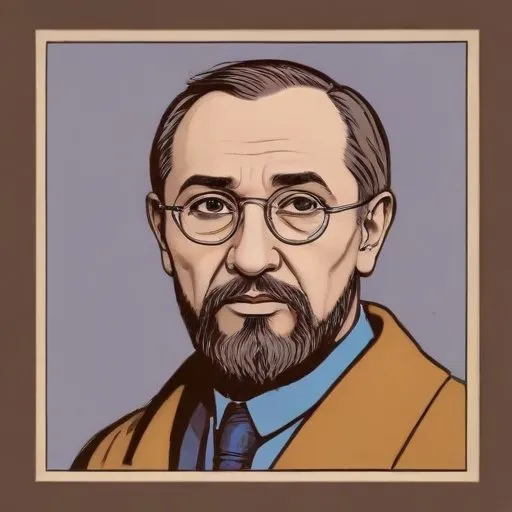
Ivan Petrovsky

Ivan Petrovsky

Ivan Petrovsky was born on January 18th, 1901

Full Name: Ivan Georgievich Petrovsky
Place of Birth: Sevastopol, Russia
Profession: Mathematician and Academic
Nationality: Russian
Born: January 18, 1901
Died: January 15, 1973
Notable Work: Partial Differential Equations
Field: Mathematics

Developed theories on algebraic geometry and partial differential equations, making significant contributions to the field of mathematics.

Written by: Grace Lee Grace Lee

Ivan Petrovsky: The Pioneering Mathematician

Ivan Georgiyevich Petrovsky, a renowned Soviet mathematician, revolutionized the field of partial differential equations, making significant contributions to the solution of Hilbert's 19th and 16th problems. His groundbreaking work on Petrovsky lacunas has had a lasting impact on the mathematical community.

Early Life and Education

Ivan Petrovsky was born on January 18, 1901, in Russia. He pursued his mathematical interests under the guidance of Dmitri Egorov, a prominent mathematician of the time.

Contributions to Mathematics

Petrovsky's work on partial differential equations, boundary value problems, probability, and topology of algebraic curves and surfaces has been instrumental in shaping the field. His solutions to Hilbert's 19th and 16th problems have had far-reaching implications for mathematicians worldwide.

Career Highlights and Major Works

Petrovsky taught at the Steklov Institute of Mathematics and later became the president of Moscow State University from 1951 to 1973. He was also the head of the International Congress of Mathematicians in Moscow in 1966.

Some of his notable publications include:

Awards and Honors

For his outstanding contributions to mathematics, Petrovsky was awarded the title of Hero of Socialist Labour in 1969. He was also a member of the Academy of Sciences of the Soviet Union since 1946.

Legacy

Ivan Petrovsky's work has had a profound impact on the development of mathematics, influencing generations of mathematicians. His legacy continues to inspire research and advancements in the field of partial differential equations.

Petrovsky passed away on January 15, 1973, in Moscow, and was buried in the Novodevichy Cemetery. His contributions to mathematics remain a testament to his dedication and passion for the subject.

Timeline
1903
Born in Russia
Ivan Petrovsky was born on January 18, 1903, in Sevsk, Russia. He would later become a renowned Russian mathematician and academic.
1924
Graduates from Moscow University
Petrovsky graduates from Moscow University, where he would later become a professor and make significant contributions to mathematics.
1943
Elected to Academy of Sciences
Petrovsky is elected to the Academy of Sciences of the Soviet Union, a prestigious honor for his contributions to mathematics.
1951
Becomes Rector of Moscow University
Petrovsky becomes the Rector of Moscow University, a position he would hold until his death in 1973.
1973
Passing Away
Ivan Petrovsky passes away on January 15, 1973, at the age of 69, leaving behind a legacy as a prominent Russian mathematician and academic.
Ivan Petrovsky

Ivan Petrovsky Quiz

Ivan Petrovsky's work had a significant impact on which branch of mathematics?

Score: 0/5
FAQ
What contributed to Ivan Petrovskys influence on mathematics?
Ivan Petrovskys work on partial differential equations and potential theory significantly contributed to his influence on mathematics. His research in these areas has had a lasting impact on the field, earning him recognition as one of the most important mathematicians of the 20th century.
What is Ivan Petrovskys most notable mathematical contribution?
Ivan Petrovskys most notable mathematical contribution is his work on the Petrovsky lacuna, a concept in partial differential equations. This concept has been widely applied in various fields, including physics, engineering, and mathematics.
What role did Ivan Petrovsky play in Russian academia?
Ivan Petrovsky played a significant role in Russian academia, serving as the rector of Moscow State University from 1951 to 1970. During his tenure, he oversaw significant reforms and modernization efforts, establishing the university as a premier institution for higher education in Russia.
What was Ivan Petrovskys impact on the development of mathematical education in Russia?
Ivan Petrovskys impact on the development of mathematical education in Russia was profound. He advocated for the importance of mathematics education and worked to establish mathematics as a fundamental discipline in Russian universities, leading to significant advances in mathematical research and education.
What honors did Ivan Petrovsky receive for his contributions to mathematics?
Ivan Petrovsky received numerous honors for his contributions to mathematics, including the Stalin Prize, the Lenin Prize, and the title of Hero of Socialist Labor. These honors recognize his significant contributions to the field and his impact on Russian academia.

Related People:

Andrey Kolmogorov

Born in 1903

Developed theories on probability, topology, and complexity, making significant contributions to modern mathematics and computer science.

Sergei Sobolev

Born in 1908

Developed the theory of distributions, a fundamental concept in mathematics, and made significant contributions to the fields of calculus, functional analysis, and partial differential equations.

Aleksandr Khinchin

Born in 1894

A Soviet mathematician who made significant contributions to the field of probability theory, particularly in the development of the Khinchin theorem.

Nikolai Luzin

Born in 1883

A renowned mathematician who developed descriptive set theory and made significant contributions to topology, function theory, and number theory, leaving a lasting impact on modern mathematics.

Mikhail Lavrentyev

Born in 1900

A renowned mathematician and hydrodynamicist who made significant contributions to the development of hydrodynamics, aerodynamics, and gas dynamics, and is credited with founding the Siberian Branch of the Soviet Academy of Sciences.

Andrey Markov

Born in 1856

Developed the theory of Markov chains, a mathematical system that undergoes transitions from one state to another, and is widely used in computer science, biology, and economics.