


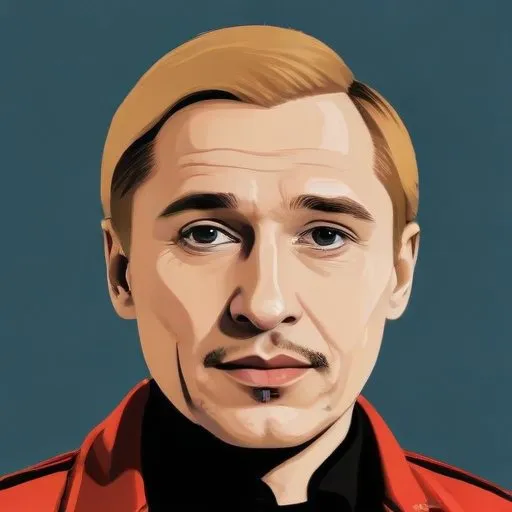
Acclaimed Russian filmmaker behind poignant, often darkly comedic dramas that explore human nature and societal issues, earning numerous international awards and critical acclaim.
Aleksandr Vladimirovich Rogozhkin, a renowned Russian film director and writer, is best known for his thought-provoking and visually stunning films that delve into the complexities of human nature, war, and Russian culture. His 2002 film, The Cuckoo, won widespread critical acclaim, earning him the Golden Eagle Award for Best Picture, Best Screenplay, Best Directing, and Best Feature Film.
Born on October 3, 1949, in Leningrad, Soviet Union (now St. Petersburg, Russia), Rogozhkin grew up in a family of intellectuals. His father, Vladimir Rogozhkin, was a scientist, and his mother, Lyudmila Rogozhkina, was a philologist. This exposure to the world of arts and sciences laid the foundation for Rogozhkin's future career in filmmaking.
Rogozhkin's breakthrough film, Karaul, released in 1990, won the Alfred Bauer Prize at the 40th Berlin International Film Festival. This recognition marked the beginning of his successful career, which would span over three decades.
In 1992, his film The Chekist was screened in the Un Certain Regard section at the Cannes Film Festival, further solidifying his reputation as a bold and innovative filmmaker.
Rogozhkin's films often tackle difficult subjects, including war and social commentary. His 1998 film, Blokpost, was one of the first to address the Chechen War, showcasing his courage to confront harsh realities.
In addition to his feature films, Rogozhkin has made significant contributions to Russian television. His work on the popular police procedural series, Streets of Broken Lights, and the spinoff series Deadly Force, has earned him a reputation as a master of storytelling.
Rogozhkin has also directed a series of popular Russian-language screwball comedies, including Peculiarities of National... and Operation Happy New Year, which have become cult classics in Russia.
Rogozhkin's work has been recognized with numerous awards and nominations, including the Golden Eagle Award, Nika Awards, and Honfleur Russian Film Festival Awards. His films have been screened at prominent international film festivals, including Berlin, Cannes, and Moscow.
Aleksandr Rogozhkin's legacy in Russian cinema is undeniable. His unique storytelling style, which often blends drama, humor, and social commentary, has inspired a new generation of filmmakers.
Rogozhkin's personal life has been marked by significant milestones, including his marriage to actress and producer, Natalya Zhelanova. He is known for his humble and down-to-earth personality, which has earned him the respect and admiration of his peers.
Aleksandr Rogozhkin's passing on October 23, 2021, marked the end of an era in Russian cinema. However, his films continue to inspire and captivate audiences worldwide, ensuring his legacy as a visionary filmmaker.
Aleksandr Rogozhkin's life and work serve as a testament to the power of storytelling and the impact one person can have on the world of cinema.
81 Years Old
Acclaimed Russian filmmaker behind epic historical dramas and poignant family sagas, exploring themes of love, power, and identity. His cinematic masterpieces have captivated global audiences.
89 Years Old
Acclaimed Russian filmmaker behind cinematic masterpieces like "Runaway Train" and "Shy People", known for his thought-provoking, visually stunning storytelling.
94 Years Old
A visionary filmmaker who explored the human condition through poetic, visually stunning, and introspective movies that continue to inspire artists and audiences alike.
Born in 1898
A pioneer of montage editing, he revolutionized filmmaking with his iconic scenes and theories, influencing generations of directors.
Born in 1896
A pioneering filmmaker who experimented with documentary and narrative styles, known for his innovative and influential works that pushed the boundaries of cinematic storytelling.
Born in 1920
A renowned filmmaker who directed epic historical dramas, including a seven-hour adaptation of Tolstoy's "War and Peace" that won the Academy Award for Best Foreign Language Film.
