


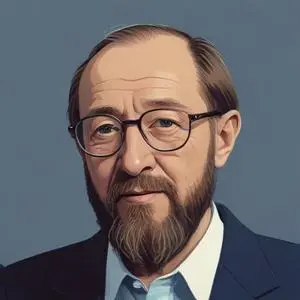
A Russian literary giant who exposed the harsh realities of Soviet forced labor camps through his writings, earning him a Nobel Prize in Literature.
Aleksandr Solzhenitsyn, the Russian author and Soviet dissident, is renowned for exposing the harsh realities of political repression in the Soviet Union, particularly the atrocities of the Gulag prison system. Through his literary masterpieces, he brought global attention to the dark secrets of the Soviet regime, earning him the 1970 Nobel Prize in Literature.
Solzhenitsyn was born on December 11, 1918, into a devout Russian Orthodox family that defied the Soviet antireligious campaign in the 1920s. Growing up, he struggled with his faith, eventually becoming an atheist and embracing Marxism-Leninism.
During World War II, Solzhenitsyn served as a captain in the Red Army, where he was arrested by SMERSH and sentenced to eight years in the Gulag and subsequent internal exile. The experience had a profound impact on him, leading to a gradual return to his Christian roots.
Solzhenitsyn's writing career took off after his release from the Gulag. His first novel, One Day in the Life of Ivan Denisovich, published in 1962, provided a scathing critique of Stalinist repression. The novel's success was followed by Cancer Ward (1966), In the First Circle (1968), August 1914 (1971), and his magnum opus, The Gulag Archipelago (1973).
The Gulag Archipelago, a three-volume work, presented a damning account of the Soviet forced labor camp system. The book's publication in 1973 sparked international outrage, cementing Solzhenitsyn's status as a leading Soviet dissident.
In 1974, Solzhenitsyn was stripped of his Soviet citizenship and deported to West Germany. He continued to write, producing works like The Oak and the Calf (1975) and Invisible Allies (1995). Solzhenitsyn returned to Russia in 1994, where he lived until his death on August 3, 2008.
Solzhenitsyn's experiences led him to become a philosophically minded Eastern Orthodox Christian. He advocated for individual freedom, moral responsibility, and the importance of preserving Russian cultural heritage.
Solzhenitsyn's work had a profound impact on modern society, influencing the global perception of the Soviet Union and its human rights record. His literary legacy continues to inspire writers, dissidents, and freedom fighters around the world.
"One word of truth outweighs the world."
"You can resolve to live your life with integrity. Let your credo be this: Let the lie come into the world, let it even triumph. But not through me."
Aleksandr Solzhenitsyn's courage, literary genius, and unwavering commitment to exposing the truth have left an indelible mark on human history. His legacy serves as a testament to the power of individual resistance against oppression, inspiring generations to come.
95 Years Old
The last leader of the Soviet Union, who introduced reforms that led to the end of the Cold War and the collapse of communism, earning a Nobel Peace Prize. He's known for his policies of glasnost and perestroika, which transformed the Soviet Union and the world.
Born in 1878
The Soviet Union's ruthless leader who ruled with an iron fist, implementing policies that led to widespread famine and purges, while also playing a crucial role in defeating Nazi Germany in World War II.
73 Years Old
A Russian politician who has dominated the country's politics for over two decades, known for his authoritarian leadership style and controversial foreign policy decisions.
Born in 1828
A Russian literary giant who penned sweeping novels like "War and Peace" and "Anna Karenina", exploring the human condition with profound insight and masterful storytelling.
Born in 1821
A Russian literary mastermind who penned psychologically complex novels that probed the human condition, exploring themes of morality, philosophy, and the darker aspects of human nature.
Born in 1899
A Russian-born novelist and critic, renowned for crafting intricate, lyrical prose and exploring themes of identity, morality, and the human condition through works like "Lolita" and "Pale Fire".
Born in 1921
A Soviet physicist and dissident who advocated for human rights and nuclear disarmament, earning a Nobel Peace Prize in 1975. He's known for his courageous stance against the Soviet regime, promoting peace and democracy.
Born in 1888
A prominent figure in the Russian Revolution, he was a key architect of the Soviet economy and a vocal critic of Stalin's regime, ultimately falling victim to his purges.
