


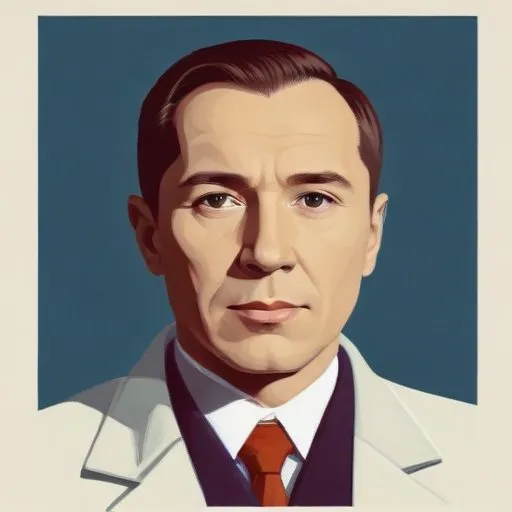
Russian physicist and academic who made significant contributions to the development of electromagnetic theory and invented the first photoelectric cell, paving the way for modern solar panels.
Aleksandr Stoletov, a renowned Russian physicist, is best known for his pioneering work in the field of ferromagnetism and his discovery of the laws and principles of the outer photoelectric effect. He is considered one of the founders of electrical engineering and has made significant contributions to the development of modern physics.
Aleksandr Stoletov was born on August 10, 1839, in Russia. He came from a family of intellectuals and was the brother of General Nikolai Stoletov. Stoletov's interest in physics began at a young age, and he pursued his passion by studying physics at Moscow University. In 1872, he defended his doctoral dissertation, which marked the beginning of his illustrious career as a scientist.
Stoletov's major contributions to science include his work on ferromagnetism and the outer photoelectric effect. In 1871, he was the first to show that the magnetic susceptibility of iron increases with the magnetic field, but then decreases. He also developed two new methods for measuring magnetic properties of various materials and built the curve of magnetic permeability of ferromagnetics, known as the Stoletov curve.
In the field of photoelectric effect, Stoletov studied the outer photoelectric effect, discovered by Hertz in 1887. He published his results in six works and developed quantitative methods for the study of the photoelectric effect. Stoletov's law, which states that the photo-induced current is directly proportional to the intensity of light, is a fundamental concept in the field of photoelectricity.
Stoletov's work has had a significant impact on modern society, and he is considered one of the founders of electrical engineering. His contributions to the field of ferromagnetism and photoelectricity have paved the way for numerous scientific advancements and technological innovations.
Stoletov's work has had far-reaching implications for modern technology. His discovery of the outer photoelectric effect has led to the development of solar cells, which are now used to generate electricity in various applications. His work on ferromagnetism has also contributed to the development of magnetic storage devices, such as hard drives and magnetic resonance imaging (MRI) machines.
Stoletov's contributions to science were recognized during his lifetime, and he received several awards and honors for his work. He was a professor at Moscow University and attended the opening ceremony of the physical laboratory in Cambridge in 1874. He also represented Russia at the first World Congress of Electricity in Paris in 1881, where he presented his work on links between electrostatic and electromagnetic values.
Stoletov's personal life was marked by his dedication to his work and his passion for science. He was a member of several scientific societies and attended various conferences and meetings, where he presented his research and shared his ideas with other scientists.
Throughout his life, Stoletov remained committed to his work and continued to make significant contributions to the field of physics. He passed away on May 27, 1896, but his legacy lives on through his groundbreaking work, which has had a lasting impact on modern society.
Aleksandr Stoletov's contributions to science have paved the way for numerous technological innovations, and his legacy continues to inspire scientists and engineers around the world.
Born in 1834
Creator of the periodic table of elements, organizing them by properties and predicting unknown elements. This groundbreaking work revolutionized chemistry and remains a fundamental tool today.
Born in 1846
Developed groundbreaking theories on electromagnetism and relativity, paving the way for modern physics. His work on the concept of energy density laid the foundation for future breakthroughs.
Born in 1907
A pioneering rocket engineer and designer who played a crucial role in the Soviet space program, developing the R-7 rocket that launched Sputnik and sent humans into space.
Born in 1711
A Russian polymath who made significant contributions to various fields, including the discovery of the atmosphere of Venus and the development of a comprehensive theory of the Earth's origin. They are also credited with founding Moscow State University.
Born in 1857
Pioneering rocket scientist and engineer who developed the theoretical foundations of modern astronautics, including the concept of multistage rockets and space exploration.
Born in 1849
A Russian physiologist and physician who discovered the concept of classical conditioning, where he demonstrated that animals can learn to associate stimuli with a particular response, revolutionizing our understanding of behavior. His work laid the foundation for behavioral psychology and continues to influence fields like education and advertising.
Born in 1792
Developed a new branch of geometry, non-Euclidean geometry, which challenged traditional views and paved the way for major advancements in mathematics and physics. His work also influenced the development of Einstein's theory of relativity.
Born in 1863
Developed the concept of the noosphere, which posits that the Earth's biosphere is evolving into a sphere of thought and consciousness, and founded the Ukrainian Academy of Sciences. He's also known for his work on the Earth's biosphere and the development of geochemistry.
