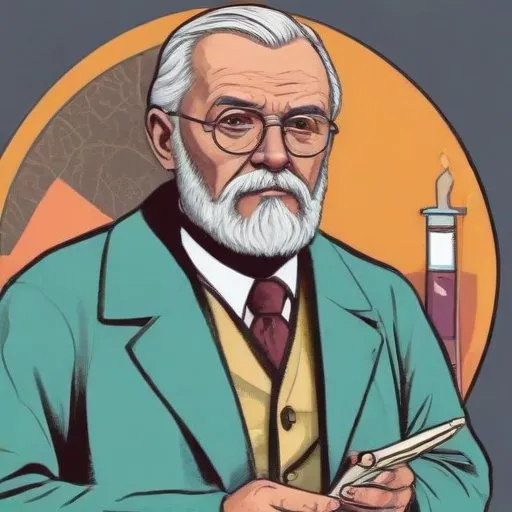
Vladimir Vernadsky: The Visionary Who Illuminated the Biosphere
The Founder of Geochemistry and Radiogeology
Vladimir Ivanovich Vernadsky is renowned for his seminal work in geochemistry, biogeochemistry, and radiogeology, earning him the title of one of the founders of these disciplines. His groundbreaking book,
The Biosphere, published in 1926, revolutionized the scientific community by highlighting the profound impact of life on the Earth's geological processes.
A Life of Academic Pursuits
Born on March 12, 1863 (February 28, O.S.), in Saint Petersburg, Russian Empire, Vernadsky was immersed in an environment of intellectual curiosity from an early age. His father, Ivan Vernadsky, was a professor of political economy, and his mother, Anna Konstantinovich, was a music instructor from an old Russian noble family. Vernadsky's family relocated to Kharkiv in 1868, where he attended the local provincial gymnasium. He later graduated from Saint Petersburg State University in 1885, where he was drawn to mineralogy due to the influence of prominent scientists Vasily Dokuchaev and Alexey Pavlov.
The Biosphere: A Paradigm Shift
Vernadsky's magnum opus,
The Biosphere, introduced the concept that life is a geological force that shapes the Earth. This idea, although inspired by Eduard Suess's 1875 term "biosphere," was Vernadsky's unique contribution to the scientific community. By recognizing the interconnectedness of living organisms and the Earth's geological processes, Vernadsky laid the foundation for modern biogeochemistry and radiogeology.
Awards and Honors
Vernadsky's contributions to science were recognized with the prestigious Stalin Prize in 1943. His portrait has the distinction of being featured on the Ukrainian 1,000 hryvnia banknote, a testament to his enduring legacy in Ukraine.
Influence on Modern Society
Vernadsky's work has far-reaching implications for our understanding of the Earth's systems and the delicate balance between living organisms and the environment. His ideas have influenced fields such as ecology, environmental science, and geology, shaping our perception of the intricate relationships within the biosphere.
Philosophical Contributions and Beliefs
Vernadsky's work embodies a profound respect for the natural world and a deep understanding of the interconnectedness of living organisms. His ideas encourage a holistic approach to understanding the Earth's systems, emphasizing the importance of preserving the delicate balance of the biosphere.
Personal Milestones and Key Life Events
- 1863: Born in Saint Petersburg, Russian Empire
- 1868: Family relocates to Kharkiv
- 1885: Graduates from Saint Petersburg State University
- 1926: Publishes The Biosphere
- 1943: Awarded the Stalin Prize
- 1945: Passes away on January 6
Legacy and Impact
Vernadsky's pioneering work has left an indelible mark on the scientific community. His ideas continue to inspire researchers, policymakers, and environmentalists, guiding us toward a deeper appreciation of the intricate relationships within the biosphere. As we face the challenges of the 21st century, Vernadsky's vision serves as a beacon, illuminating the path toward a more harmonious coexistence with the natural world.
FAQ
What were Vladimir Vernadskys contributions to geology and mineralogy?
Vladimir Vernadsky was a Russian and Ukrainian mineralogist and chemist who made significant contributions to the fields of geology and mineralogy. He is known for his work on the formation of minerals and the composition of the Earths crust.
What was Vladimir Vernadskys theory of the biosphere?
Vernadskys theory of the biosphere posits that the Earths crust is a complex, interconnected system that includes living organisms, rocks, and minerals. He believed that living organisms play a crucial role in shaping the Earths environment.
How did Vladimir Vernadskys work influence the development of environmental science?
Vernadskys work on the biosphere and the interconnectedness of living organisms and the environment helped lay the foundation for the development of environmental science. His ideas continue to influence environmental research and policy today.
What was Vladimir Vernadskys legacy in the scientific community?
Vernadskys legacy is that of a pioneering scientist who helped shape our understanding of the Earths systems and the role of living organisms in shaping the environment. He is remembered as one of the founders of modern geology and mineralogy.