


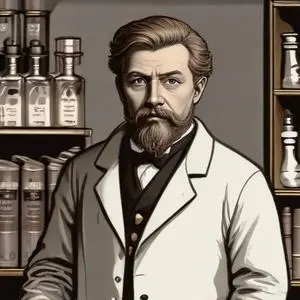
Developed the modern system of chemical notation and discovered several elements, including silicon and selenium. He's considered the father of Swedish chemistry.
Jöns Jacob Berzelius is renowned for being one of the founders of modern chemistry, alongside Robert Boyle, John Dalton, and Antoine Lavoisier. He is credited with making significant contributions to the fields of electrochemistry, chemical bonding, and stoichiometry, earning him the title of the "Last Universal Chemist."
Berzelius was born on August 20, 1779, in Väfversunda, Sweden. He began his academic pursuits at the University of Uppsala, where he initially studied medicine and later shifted his focus to chemistry. In 1802, he earned his Ph.D. in medicine, but it was his passion for chemistry that drove his future endeavors.
Berzelius' most notable contributions include:
Berzelius' work on stoichiometry led to the development of the Law of Constant Proportions, which states that chemical compounds contain elements in definite proportions. This fundamental principle revolutionized the field of chemistry and paved the way for future discoveries.
Berzelius' contributions had a profound impact on modern chemistry. He was a strict empiricist, ensuring that any new theories were consistent with the sum of contemporary chemical knowledge. His work influenced generations of chemists, and he is still regarded as one of the most important scientists of his time.
Berzelius was elected a member of the Royal Swedish Academy of Sciences in 1808 and served as its principal functionary from 1818. He was also awarded the Copley Medal in 1836 for his outstanding contributions to chemistry.
Berzelius never married and dedicated his life to science. He was known for his kindness, modesty, and generosity, often supporting young scientists and providing them with opportunities to advance their careers.
Berzelius lived during a time of significant scientific discovery, and his work built upon the foundations laid by his contemporaries. His contributions not only advanced the field of chemistry but also paved the way for future breakthroughs in related fields like physics and biology.
Did you know that Berzelius was known for his meticulous attention to detail? He was said to have performed over 2,000 experiments during his research on atomic weights.
Berzelius' legacy continues to inspire scientists and chemists around the world. His groundbreaking work has left an indelible mark on the field of chemistry, earning him the esteemed title of the "Father of Swedish Chemistry."
Born in 1743
Father of modern chemistry, discovered oxygen, and developed a systematic method of chemical nomenclature. He laid the foundation for modern chemistry and paved the way for future scientific discoveries.
Born in 1778
Pioneering chemist and physicist who discovered several elements, including potassium and sodium, and invented the Davy lamp, a safety lamp for miners. His groundbreaking work laid the foundation for modern chemistry and electrochemistry.
Born in 1745
Italian physicist who invented the first electrical battery, revolutionizing the field of electricity and paving the way for countless technological advancements.
Born in 1791
Pioneering scientist who discovered electromagnetic induction, formulated the laws of electrolysis, and invented the first electrical generator, revolutionizing our understanding of electricity and its applications.
