


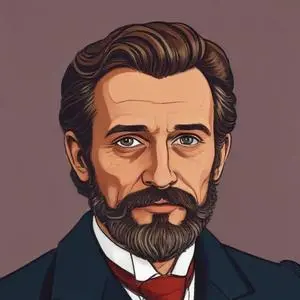
German chemist and academic who synthesized urea, debunking the theory of vitalism, and made significant contributions to organic chemistry. He is considered one of the founders of modern organic chemistry.
Friedrich Whler, a German chemist, is renowned for being the first to isolate the chemical elements beryllium and yttrium in pure metallic form, as well as for his groundbreaking work in both organic and inorganic chemistry. His most significant contribution, the Whler synthesis of urea, not only challenged the prevailing belief that organic compounds could only be produced by living organisms but also paved the way for modern organic chemistry.
Whler was born on July 31, 1800, in Eschersheim, Germany, to a veterinarian father. From a young age, he showed a keen interest in mineral collecting, drawing, and science. He received his secondary education at the Frankfurt Gymnasium, where he began conducting chemical experiments in a home laboratory provided by his father.
Whler enrolled at Marburg University in 1820 and later moved to Heidelberg University, where he passed his examinations as a Doctor of Medicine, Surgery, and Obstetrics in 1823. It was during this period that he came under the guidance of chemist Leopold Gmelin, who encouraged him to focus on chemistry and arranged for him to conduct research under the direction of Jacob Berzelius in Stockholm, Sweden.
This marked the beginning of a long-standing personal and professional relationship between Whler and Berzelius. Whler went on to translate many of Berzelius' scientific writings into German for international publication, solidifying his position as a prominent chemist in his own right.
From 1826 to 1831, Whler taught chemistry at the Polytechnic School in Berlin, during which time he made significant contributions to the field. Some of his notable works include:
Whler's work, particularly the synthesis of urea, challenged the long-held belief in vitalism, which posited that organic compounds could only be produced by living organisms due to a life force. While the exact extent of Whler's role in diminishing the belief in vitalism is debated, his work undoubtedly played a significant role in shifting the paradigm towards modern organic chemistry.
In addition to his academic and professional pursuits, Whler was a prolific writer, publishing over 275 books, editions, and papers during his lifetime.
Friedrich Whler's contributions to chemistry have had a lasting impact on the field, paving the way for future generations of chemists. His work continues to influence modern organic chemistry, and his legacy serves as a testament to the power of human ingenuity and scientific inquiry.
Did you know that Whler was a skilled draftsman and artist? His love for drawing and science led him to create detailed illustrations of mineral specimens, which were later published in his book, "Das Mineralreich."
Friedrich Whler's groundbreaking work in organic chemistry has left an indelible mark on the scientific community. His contributions continue to inspire and influence chemists to this day, solidifying his place as one of the most important figures in the history of chemistry.
Born in 1803
Developed groundbreaking theories on organic chemistry and agriculture, revolutionizing farming practices and earning the title "Father of Fertilizers".
Born in 1779
Developed the modern system of chemical notation and discovered several elements, including silicon and selenium. He's considered the father of Swedish chemistry.
Born in 1818
Developed the theory of chemical structure and introduced the concept of synthetic chemistry, revolutionizing the field of organic chemistry.
Born in 1835
German chemist and Nobel laureate who synthesized barbituric acid and developed the theory of organic dyes, revolutionizing the textile industry. His work laid the foundation for modern dye chemistry.
Born in 1825
Developed the Erlenmeyer flask, a iconic laboratory vessel still widely used today, and made significant contributions to organic chemistry.
Born in 1829
A German chemist and academic who discovered the structure of benzene and founded the theory of chemical structure, revolutionizing organic chemistry.
