


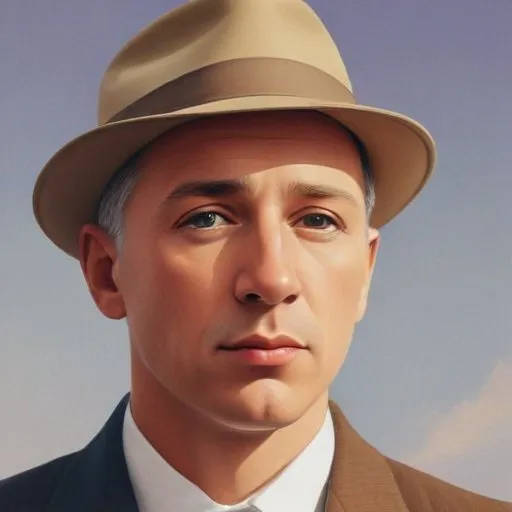
A renowned painter and academic, he created hyper-realistic and enigmatic works that explored the human condition, often featuring everyday scenes and objects. His unique style blended realism and surrealism.
Alex Colville is renowned for his hauntingly real and introspective paintings that capture the essence of everyday life, inviting viewers to confront the complexities of human existence. His unique style, often associated with Magic Realism, has earned him a distinctive place in the world of contemporary art.
Born on August 24, 1920, in Toronto, Ontario, Colville spent his formative years in St. Catharines and Amherst, Nova Scotia. He pursued his passion for art at Mount Allison University, studying under notable Canadian Post-Impressionists like Stanley Royle and Sarah Hart. During his time at Mount A, he became acquainted with Rhoda Wright, whom he would later marry in 1942.
Colville's artistic talent was soon put to use during World War II. He enlisted in the Canadian Army, eventually earning the rank of lieutenant, and was later appointed an Official War Artist in May 1944. This experience had a profound impact on his artistic vision, as he documented the horrors of war and the human condition.
As a war artist, Colville witnessed the devastating effects of conflict, including the liberation of the Bergen-Belsen concentration camp. This experience influenced his work, as seen in "Bodies in a Grave" (1946), a poignant painting that captures the horrors of the concentration camp.
After the war, Colville returned to New Brunswick and became a faculty member at Mount Allison University, where he taught from 1946 to 1963. This period marked the beginning of his journey as a celebrated artist, as he continued to develop his unique style and explore themes that would define his oeuvre.
Colville's work defies categorization, yet it is often associated with Magic Realism. His paintings are characterized by a sense of quiet contemplation, precision, and attention to detail. He draws inspiration from the ordinary, revealing the extraordinary within the mundane.
His artistic process was meticulous, involving intense observation and preparation. Colville would often create detailed preparatory drawings, which he would later translate onto canvas. This rigorous approach allowed him to capture the subtleties of human emotion and the intricate balance of light and shadow.
Alex Colville's paintings have been exhibited in renowned institutions, including the Art Association of Montreal (now the Montreal Museum of Fine Arts) and the Royal Canadian Academy of Arts. His work has inspired generations of artists, and his unique style continues to captivate audiences worldwide.
Throughout his career, Colville has received numerous accolades, including honorary degrees from Mount Allison University and the University of New Brunswick. His contributions to the world of art have been recognized with a Lifetime Achievement Award from the Canada Council for the Arts.
Alex Colville's remarkable journey serves as a testament to the power of art to transcend time and capture the essence of human experience. His paintings continue to inspire and challenge us, inviting us to pause and reflect on the beauty and complexity of life.
Born in 1877
A pioneering landscape painter who captured the essence of the Canadian wilderness, inspiring a generation of artists with his bold, expressive brushstrokes.
Born in 1885
A pioneering figure in Canadian modern art, known for vibrant, abstract landscapes that evoke a sense of spirituality and connection to nature.
Born in 1882
A prominent figure in Canadian art, known for capturing the country's rugged landscapes and founding the Group of Seven, a collective of artists who shaped the nation's artistic identity.
Born in 1873
A pioneering figure in Canadian art, known for vibrant, expressive landscapes that captured the country's rugged beauty and spirit.
Born in 1871
A pioneering artist and writer who explored the indigenous cultures of the Pacific Northwest, capturing their stories and landscapes through vibrant paintings and poignant writings.
