


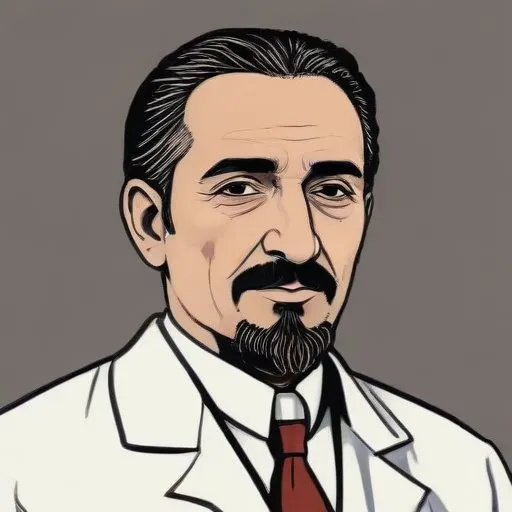
An Armenian physician and anarchist publisher who advocated for social reform and free thought through his writings and publications. He's most known for his influential anarchist journal, which sparked debates and discussions on social issues.
Alexander Atabekian, a pioneering Armenian physician and anarchist, is renowned for his unwavering dedication to the causes of social justice, anarchism, and Armenian liberation. Born on February 2, 1869, in the Nagorno-Karabakh region, Atabekian's life was a testament to his unrelenting pursuit of freedom, equality, and human rights.
Atabekian's journey began in Geneva, Switzerland, where he enrolled in the University of Geneva to study medicine. It was during this period that he developed a passion for publishing and became involved with the Social Democrat Hunchakian Party's journal, Hunchak. His experience as a typesetter and publisher laid the foundation for his future endeavors in anarchist literature.
In 1890, Atabekian became a disciple of the influential Russian anarchist Peter Kropotkin, solidifying his commitment to the anarchist movement. In Geneva, he established the Anarchist Library, which published seminal anarchist texts in Armenian and Russian, aiming to smuggle them into the Russian Empire. This endeavor demonstrated his resolve to disseminate radical ideas and challenge oppressive regimes.
Atabekian's connections with the Armenian Revolutionary Federation (ARF) led to the publication of their newspaper, Droshak, in Geneva. He then moved to Paris, where he launched the first anarchist periodical in the Armenian language, Hamaink. This publication became a platform for Atabekian to express his vision for a social revolution in Armenia, condemning the oppression of Armenians by the Ottoman Empire and European powers.
After graduating as a Doctor of Medicine, Atabekian relocated to Rasht, Iran, where he worked as a physician and published a Persian edition of Hamaink. During World War I, he served as a combat medic, treating refugees who had fled the Armenian genocide. His humanitarian work amidst the chaos of war showcased his compassion and dedication to the well-being of others.
Following the Russian Revolution of 1917, Atabekian moved to Moscow, where he penned works of anarchist theory and critique. He was a vocal critic of the rising Bolshevik regime, advocating for a more decentralized and democratic approach to socialism.
Alexander Atabekian's remarkable life exemplifies his unyielding commitment to social justice, anarchism, and Armenian liberation. Through his publishing endeavors, medical career, and wartime efforts, he left an indelible mark on the revolutionary movement of his time. As a champion of freedom and equality, Atabekian's legacy continues to inspire generations to strive for a more just and equitable society.
Alexander Atabekian's life serves as a testament to the power of unwavering dedication and the pursuit of a more just and free society.
Born in 1869
A Lithuanian-Canadian philosopher and activist who advocated for anarchism, free speech, and women's rights, playing a pivotal role in shaping modern feminist and political thought.
Born in 1842
A Russian polymath who contributed significantly to various fields, including zoology, economics, and geography, and is renowned for his anarchist philosophy and advocacy for mutual aid.
Born in 1814
A Russian philosopher and theorist who advocated for anarchism and the abolition of the state, and is known for his influence on the development of anarchist thought. His ideas emphasized individual freedom and the rejection of authority.
Born in 1870
A Lithuanian-American anarchist and writer who advocated for labor rights and prison reform through his writings and activism, including a 14-year prison sentence for attempting to assassinate a businessman.
Born in 1871
A pioneering Marxist theorist and activist who advocated for workers' rights and criticized capitalism, known for her radical ideas on revolution and democracy.
Born in 1870
Founder of the world's first socialist state, leading the Bolshevik Revolution and establishing the Soviet Union, known for his radical Marxist ideology and authoritarian rule.
Born in 1828
A Russian literary giant who penned sweeping novels like "War and Peace" and "Anna Karenina", exploring the human condition with profound insight and masterful storytelling.
Born in 1888
A Ukrainian anarchist revolutionary who led an insurrection against the Bolsheviks during the Russian Civil War, known for his charismatic leadership and innovative military tactics.
